母体 Mǔtǐ: A Summer School
July 11, 2026 – July 31, 2026
Zoom and in person
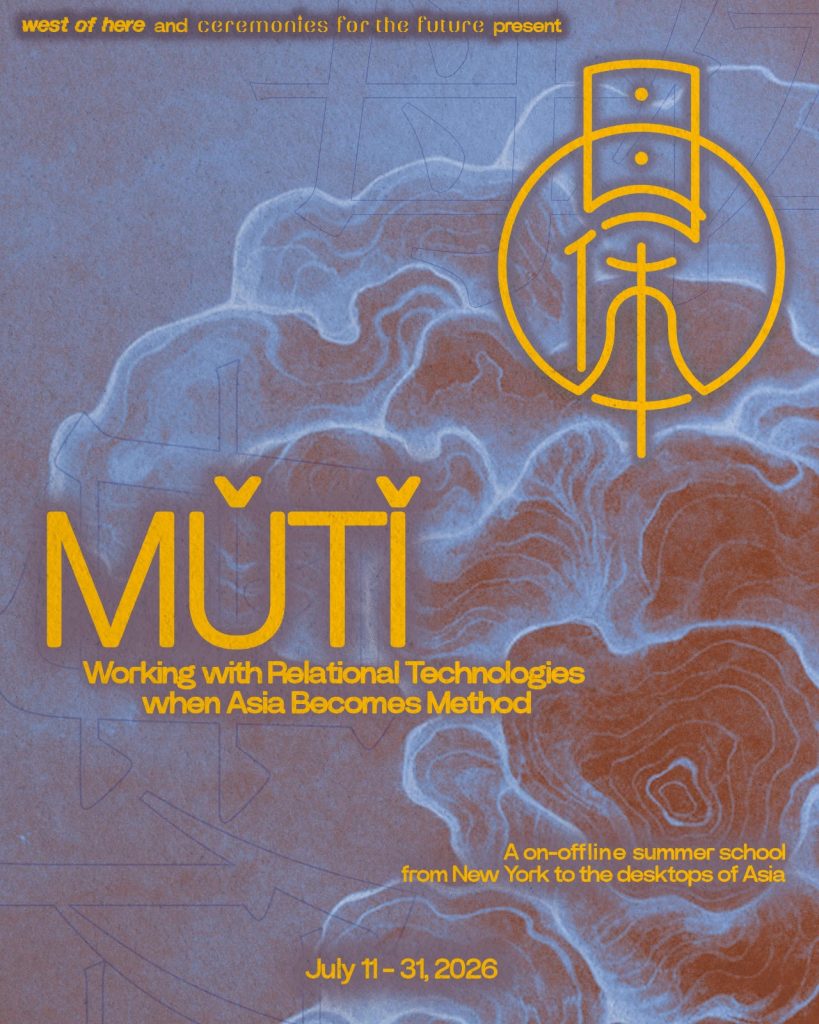
A global network of technology corporations increasingly drives us towards a reality where key human functions are outsourced to algorithms. To move beyond this paradigm, and the rhetorical frameworks of Western subjectivity, 母体 Mǔtǐ draws inspiration from Takeuchi Yoshimi’s seminal 1960 lecture “Asia as Method,” approaching Asia as a fixed geography or identity but as a vital matrix for rethinking technology itself: how it shapes perception, organizes social relations, and conditions ways of being.
Central to this inquiry is the premodern concept of 母体 Mǔtǐ (meaning mother’s body, matrix, root, originating basis), which Takeuchi invoked to describe forms of thought, processes of development, and dynamics of sociality that did not follow the trajectory of European modernity.
母体 Mǔtǐ considers a framework for a generative basis from which other technological imaginaries might emerge. Through ancestral knowledge systems, region-specific social practices, folk traditions, and ethics of production across Asia, 母体 Mǔtǐ asks: what forms of technology already exist within embodied knowledge, memory, land, ritual, and community? What non-extractive modes of relation might offer alternative technologics for an increasingly homogenized planetary condition?
Moving beyond universalized definitions of innovation and techno-progress, 母体 Mǔtǐ reimagines technology not simply as a mechanism for optimization, containment, or extraction, but as a process of deepening the intelligence that exists between us and within us.
In East Asian medicinal practice, summer is regarded as a season of restoration and nourishment; accordingly, 母体 Mǔtǐ is conceived as a generative site for repair and reorientation, metaphorically and physically akin to growth in a mother’s womb.
母体 Mǔtǐ is an on-offline summer school that will take place in New York City and via Zoom that aims to bring together artists, researchers, curators and curious minds for deep, generative conversations.