Talk
Burmese Art, Exile, and Archiving for Survival: An Interview with Chaw Ei Thein
July 23, 2026 – July 23, 2026
Asia Art Archive in America
23 Cranberry St. Brooklyn, NY
Artist Chaw Ei Thein has been a long time friend of and collaborator with Asia Art Archive in America (AAA-A). In 2010, while facing exile from her home country of Myanmar, Chaw Ei donated to AAAinA a collection of ephemera and printed matter, including exhibition announcements, small brochures, newspaper clippings, and other informational materials about artist-run spaces that emerged during the 1990s and early 2000s, primarily in the city of Yangon.
What began as a small personal collection aimed at strengthening her visa applications at embassies around the world now serves as an important physical record of an underrepresented art scene that is currently under particular duress due to ongoing political unrest in Myanmar. Since gaining independence from the United Kingdom in 1948, Myanmar has faced decades of prolonged armed conflict, ethnic-cleansing, and military coups. Yet, amid constant instability, galleries, non-profit initiatives, and talented artists continue to persist and create.
In 2026 AAAinA’s Digital Archive Fellows Jen Louie and Ravina Jain reviewed these materials with the goal of sharing the contents with wider audiences. In this endeavor, they engaged Chaw Ei in conversation about the journey these materials have taken as well as the artist’s own practice. The following transcript includes information on what items she chose to keep, why these materials matter, and how they continue to shape her artistic practice. If you are interested in accessing these materials, they are available upon request at AAAinA.
Jen Louie & Ravina Jain:
We were recently introduced to your donated materials at Asia Art Archive in America. We are thrilled to talk to you more about the collection of ephemera, photographs, and exhibition-related materials that you had donated to the organization in around 2010.
Chaw Ei Thein:
Yes. Before I moved from New York to Santa Fe—around 2012 or 2013, before I was pregnant—I had time to share these materials with AAAinA.
I had been collecting Burmese artist materials for a long time—brochures, pamphlets, whatever I could find. I also asked friends travelling to Burma to bring back materials for me.
When I checked the Asia Art Archive’s collection, material about Burmese art was lacking. There was not a lot. So I came up with the idea of collecting more.
Jen & Ravina:
Could you share how you decided what you wanted to keep in this collection?
Chaw Ei:
Well, actually, I wanted to collect and keep everything, because it is all historical, in that it speaks to what we did in the past, and especially because it’s very hard to get these materials now. They’ve been travelling from person to person without a centralized long term home.
Jen & Ravina:
Were most of these collected when you were living in Burma?
Chaw Ei:
Yes. I had been collecting from around 2007 to 2013. I donated the material to AAAinA because I did not want to keep the archive with me. I didn’t know where I would live, because I’d been exiled from my home country. I had only one piece of luggage. I could not keep carrying everything with me.
When I came to New York, I had carried the materials from London to China to Thailand to Saigon and then to New York—all that way. So they bear witness to my own history, in a sense, to my own history as well as a larger history of contemporary art in Burma. I have a personal attachment to them. I didn’t have many clothes at the time —just one suitcase—but I always brought those materials with me, especially the items about my own work and practice. So for me, this material means a lot. It is not just paper, but rather it is evidence of my personal journey.
My idea was to make an archive about my experience. By way of background, my father was an artist and collector, and he ran a gallery. He not only collected the work of important Burmese artists, but he also used to keep exhibition catalogs, brochures, books and printed materials, including material about the solo and group art exhibitions he organized. By creating this archive about my experience, I was following in my father’s footsteps. I have learned from him and his experience keeping the archives of his gallery, the Sunflower Gallery. But I knew I could not by myself take care of these materials or do the other work that archives require, like categorizing, arranging alphabetically, keeping material safe and accessible for the long term, and so on. So when I learned about AAA and met Jane, I asked her: do you have catalogs or media coverage about Burmese art and artists? They didn’t. So I wanted to help. It’s good for my country. Now whoever wants to do research can access these materials at AAAinA..
Every single paper, brochure, or pamphlet is important because my country is under civil war. Yangon is safe for now, but other regions are under very difficult circumstances. It’s hard to collect materials. That’s why I don’t want to lose even a single piece.
For me, these materials are a form of proof—they show who I am. As an exiled artist, I am always dealing with visa issues, passport issues. Showing my passport is never enough, because the Burmese passport is not strong. I have to prove who I am. That’s why I always carry a file containing my portfolio with me. Whenever I go to an embassy or need to show my passport, I can show these materials. They are very important. They have saved my life.
Jen & Ravina:
Are you still collecting today?
Chaw Ei:
Oh yes, even the other day, I had to move, so I was looking at my things trying to figure out what to keep and what to donate. I still collect pamphlets, brochures, and posters for the archive.
I love physical materials – touching them, holding them. I love that feeling. But I know I cannot bring everything with me, so I now scan material to reprint it later.
Jen & Ravina:
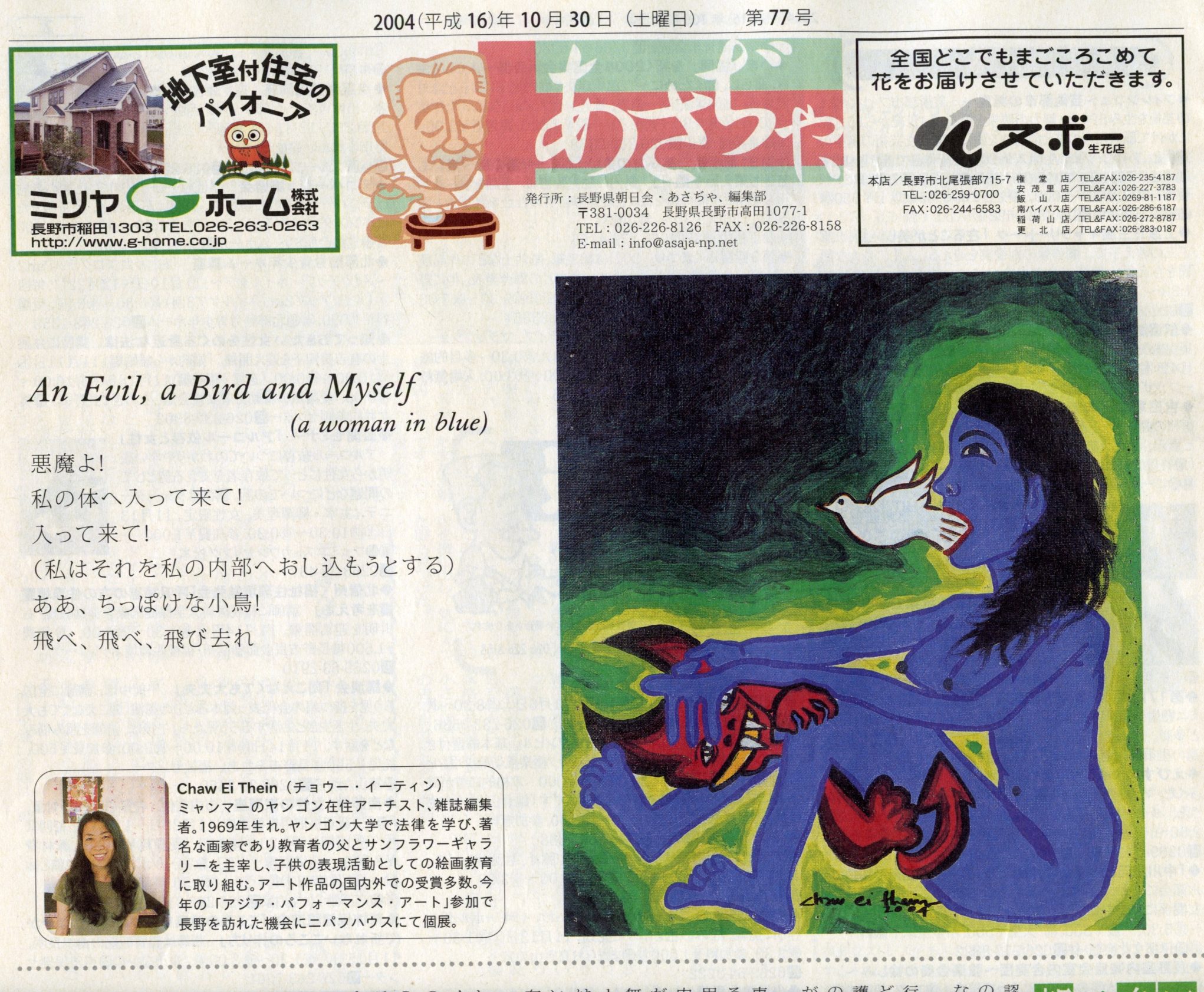
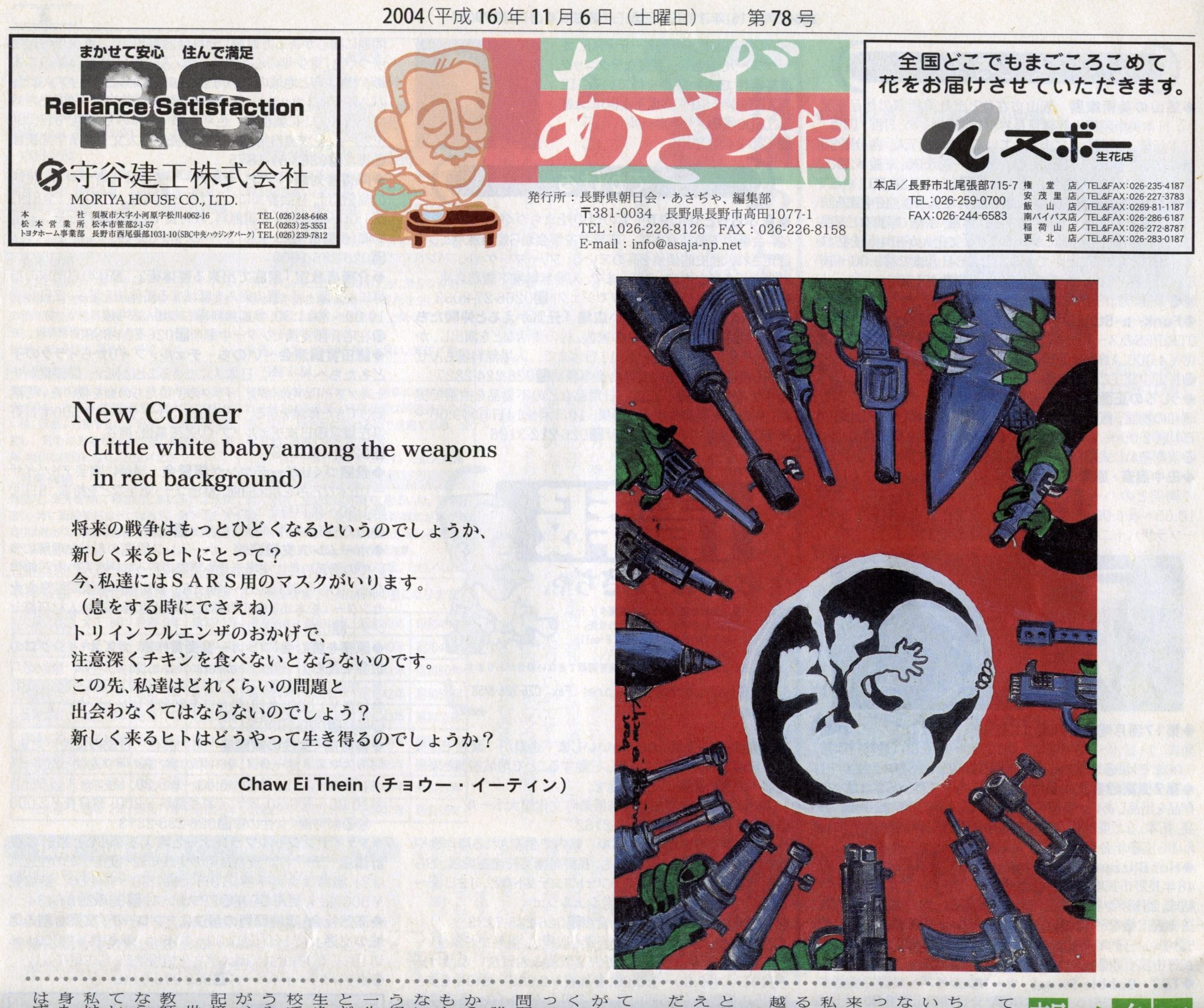
The collection includes Japanese newspaper clippings referencing your work. Why do you think the Japanese media was particularly interested in your work at that time?
Chaw Ei:
At that time (2004) I was in Nagoya where I joined a performance art festival—Nippon International Performance Art Festival. It’s well known in Southeast Asia. That year Seiji Shimoda, the organizer, invited performance artists from all over the world, especially from countries like Burma, Sri Lanka, and India, where performance art is not really known or supported. At the same time he gave me the opportunity to show my work in a solo exhibition. I also had the chance to give an artist talk. In my talk I shared my experience as a Burmese person living under military dictatorship—how we fight back in our own way, how artists use their art as a weapon.
At that time, the Japanese government was talking about upgrading its military capability, which had been restricted (by agreement with the U.S.) after their defeat in World War II. My work expressed a concern about military dictatorships, a concern that the audience shared. For this reason, a journalist wrote about my work and published several images as a warning about the potential consequences of the government changing its military policy.
One of my works depicted a baby in a mother’s womb with guns pointing toward it. In those days it seemed that the whole world was preparing for war. I was thinking about the wars in Iraq (and Afganistan), and I had also heard stories of people killing babies in parts of my country.
Upon seeing my work, an audience member contacted the local news agency. She wanted her community to know more. She felt that Japan was also a very closed society and that most Japanese people didn’t know about what’s going on in other parts of the world. The newspaper interviewed me about war, about people’s suffering, and then they printed my paintings in color on the front page four different times, each week a different painting.
Burmese people are resilient. We have been fighting back for many years, now for more than 70 years. Our country has one of the longest civil wars in the world. Not many people know about it, because Burma is not often in the media.
Jen & Ravina:
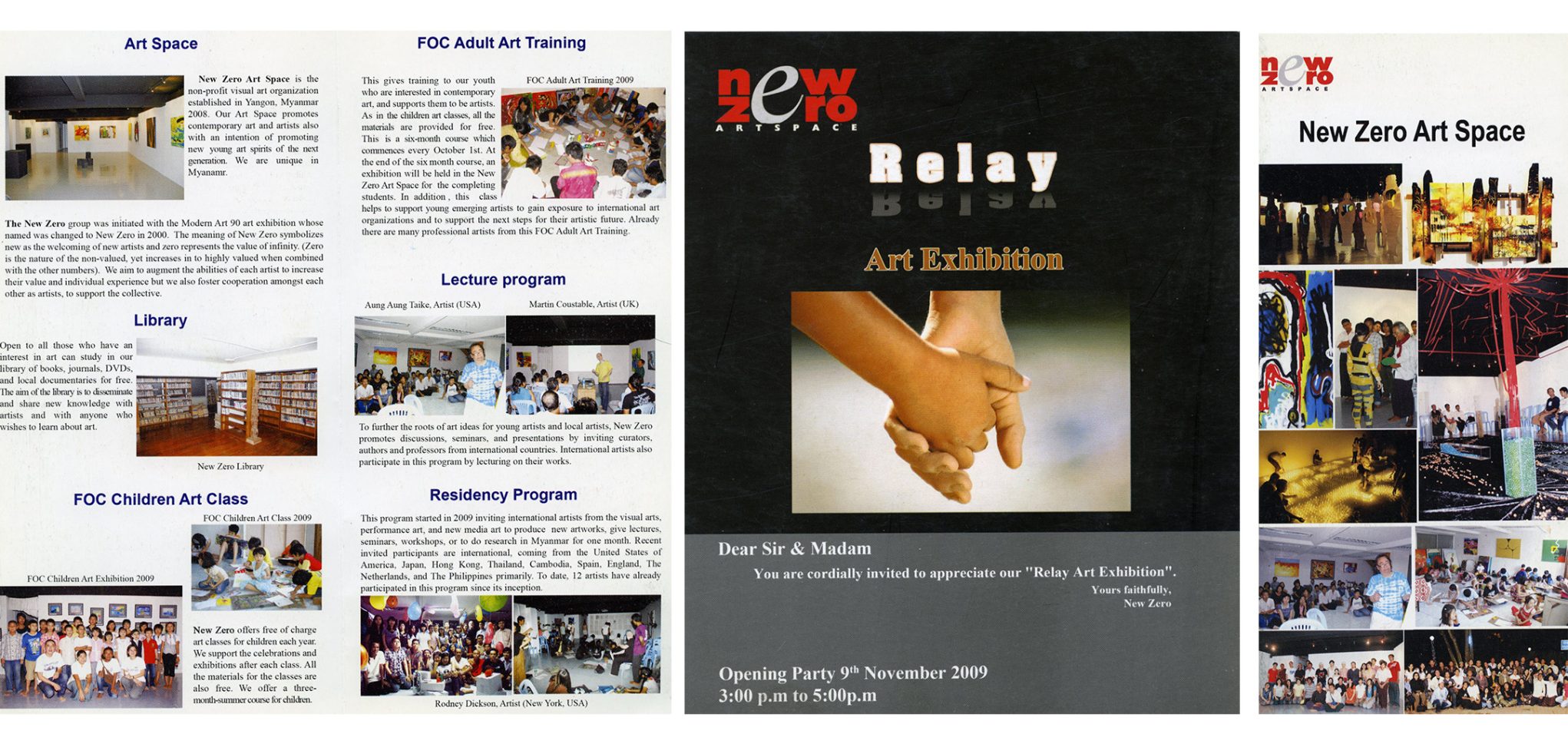
We also saw many pamphlets from New Zero Art Space. Can you tell us about this space?
Chaw Ei:
New Zero Art Space is very important for contemporary art in Burma. It was founded by Aye Ko. When Aye started it, he invited me to be an advisor, but at that time I had been arrested for a street performance. Although I was released after five days of detention, he was worried.
Aye is a painter and a performance artist, and my senior, and it’s because of him that I became a performance artist. He is also an Asian Cultural Council alumni and the person who invited Seiji Shimoda to Burma, and together with Seiji, brought international performance artists to my country.
In addition to exhibiting art, New Zero has a library and offers art classes for children, although currently there is almost no funding for it, due to the civil war, military dictatorship, and sanctions on Burma. After the pandemic, funding sources dried up.
Before I left the country around 2005 or 2006, there were only two female performance artists —me and my senior, Phyu Mon, who is also a poet. Because of New Zero, now there are more female performance artists, even more women than men.
When New Zero was established (in 2008), I was not in the country. I was in exile. The military did not renew my passport, so I could not go back. I was watching from far away in New York. I always follow what is going on there.
Jen & Ravina:
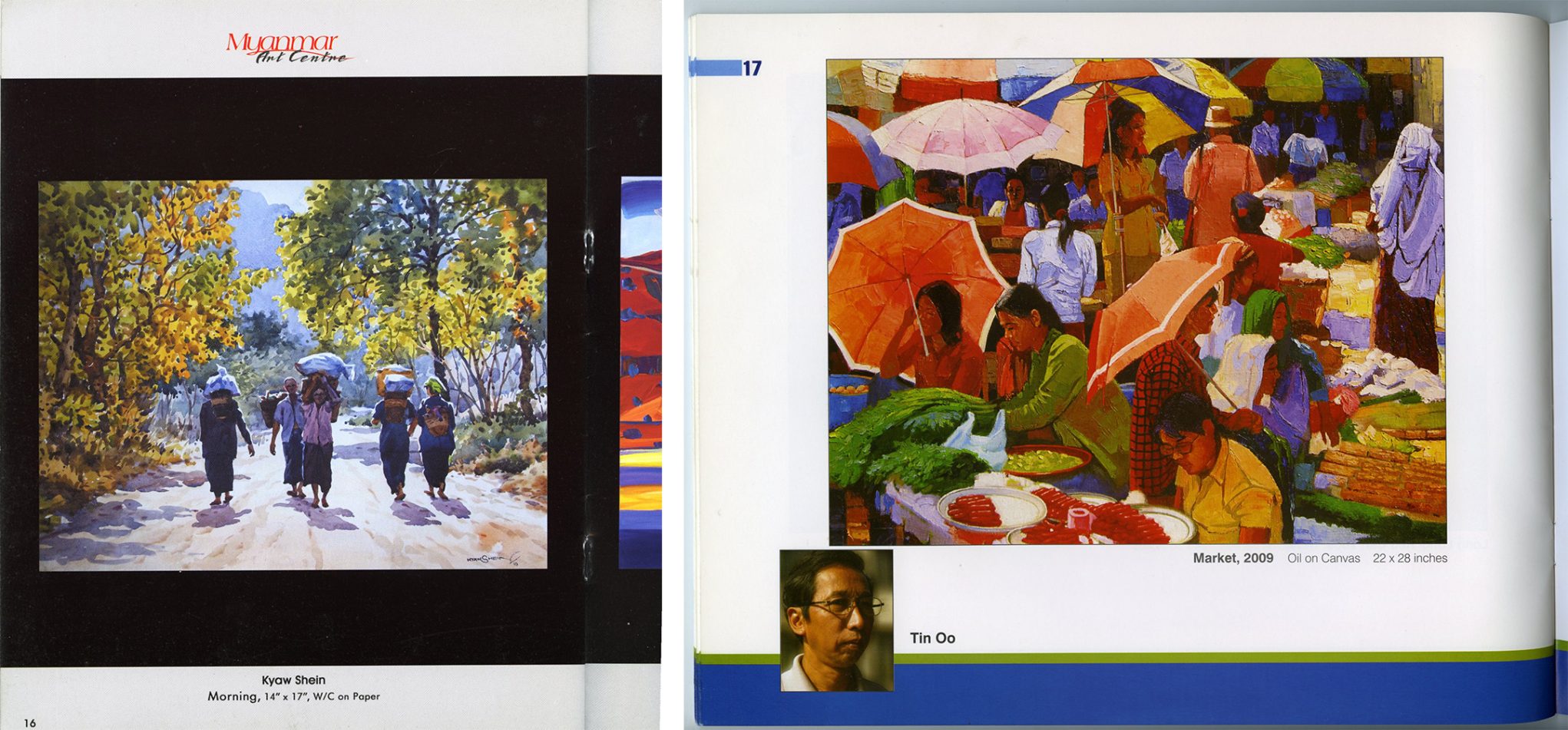
Many of the materials in the collection reference representational art. Why were these depictions of everyday life particularly popular at the time?
Chaw Ei:
Most collectors collect representational paintings, not (so-called) contemporary artwork. It is still the mainstream art form in Burma. Before the military coup, and before 2000, most collectors and dealers were from Singapore, Taiwan, Hong Kong, and other foreign countries. Then, during Aung San Suu Kyi’s administration, from 2015 until the military coup (in 2021), Burma moved forward. Sanctions were lifted and the economy grew, with the result that newly well-to-do young people started to collect. The market for Burmese art became less reliant on Singapore and Hong Kong.
When I say “representational” art I am talking about art that leans toward realism, impressionism, or modern painting. That was the mainstream style and still is, and that’s what most people collect, and that’s why I included catalogs of that kind of work in the archive. Of course, there are collectors of more experimental art – a few museums and private collectors – but that is at a much smaller scale.
For research purposes, I was and am still interested in exploring how artists, both inside Burma and in exile, navigate economic, political and social challenges in order to sustain their practice. Even now, during the current war, because of inflation, failing banks, and chaotic currency exchange, some artists support themselves by producing this kind of “mainstream” work, because people do not trust banks, so some buy art for investment purposes.
Jen & Ravina:
Thank you. Before wrapping up the conversation, we would also like to ask you about your own art practice. Are there pivotal artists, movements, or thinkers that influence your practice?
Chaw Ei:
In Burmese, we say we have three kinds of teachers: the teachers who teach us in person, the ones we learn from by hearing about them, and the ones we learn from by seeing their work. I have had many teachers – many influences. I have been influenced by colleagues, fellow artists, and international artists. It’s hard to name just one. I absorb everything, and it all comes together.
When you look at my art, you won’t see any one style. I always change by exploring different materials, different ideas. I usually work in performance art and painting. But now, I am in Berlin and have just finished a series of soft sculpture works. When you look at the whole body of my work, you might think many artists were involved, but it is only me. I have been criticized because my style of my work isn’t easily identifiable. But I don’t care. I don’t need or want to have one style.
Jen & Ravina:
Can you tell us more about your recent soft sculptures?
Chaw Ei:
I’ve been interested in soft sculpture for many reasons. Performance art is live. You perform in front of an audience, and then it’s gone. What’s left are photos and video, but that is documentation, not the artwork itself. So for a while now, I have been thinking about how to make performance into 3D sculpture. I started with clay. I even took classes about clay. I spent money on it. But clay is fragile and shipping is costly.
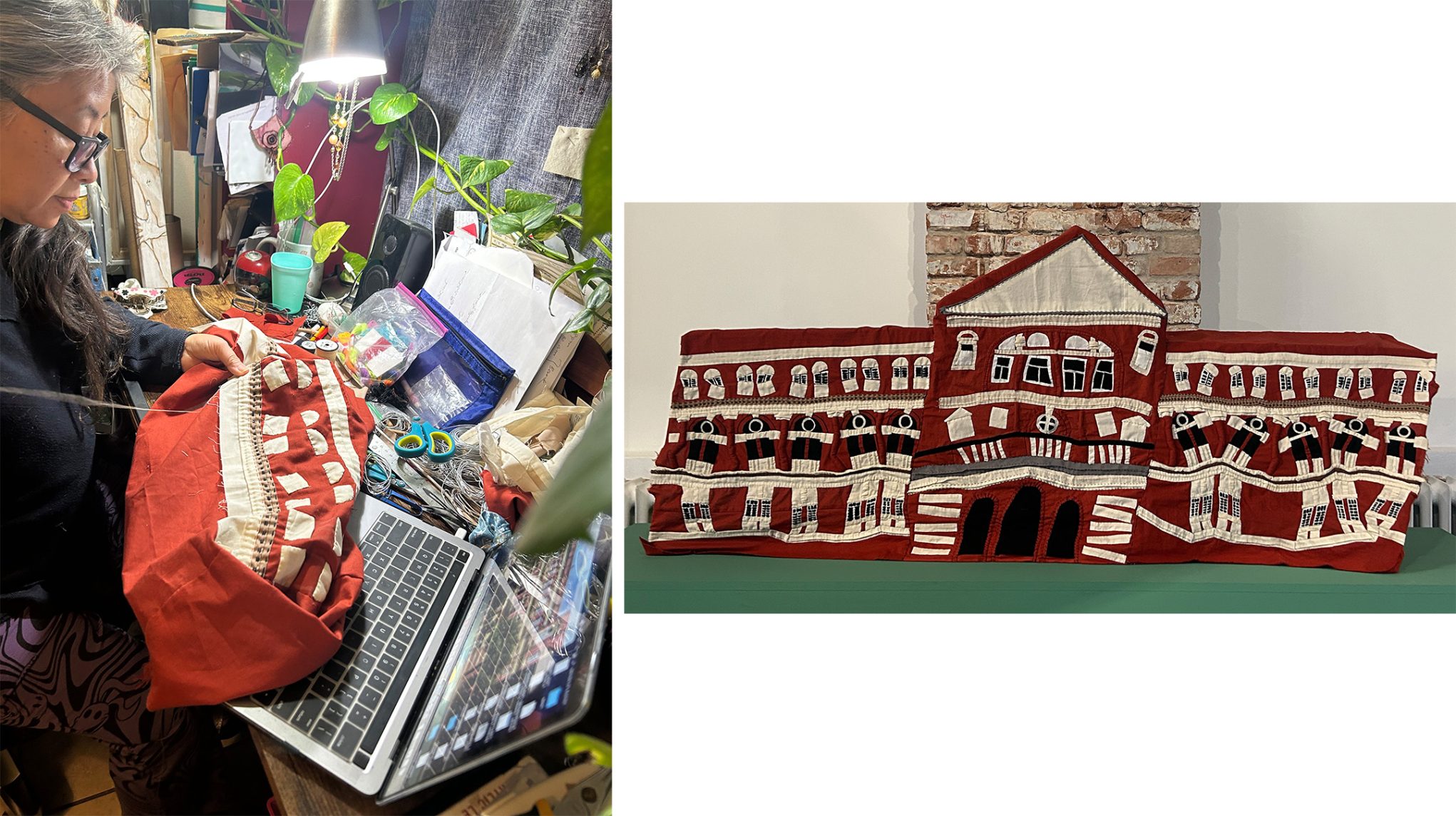
As a Burmese person living under military dictatorship, I have always faced challenges—how to survive despite difficulties. I am used to looking for alternative ways of doing things. So I decided to try working with fabric and hand stitching. I like to show the labor.
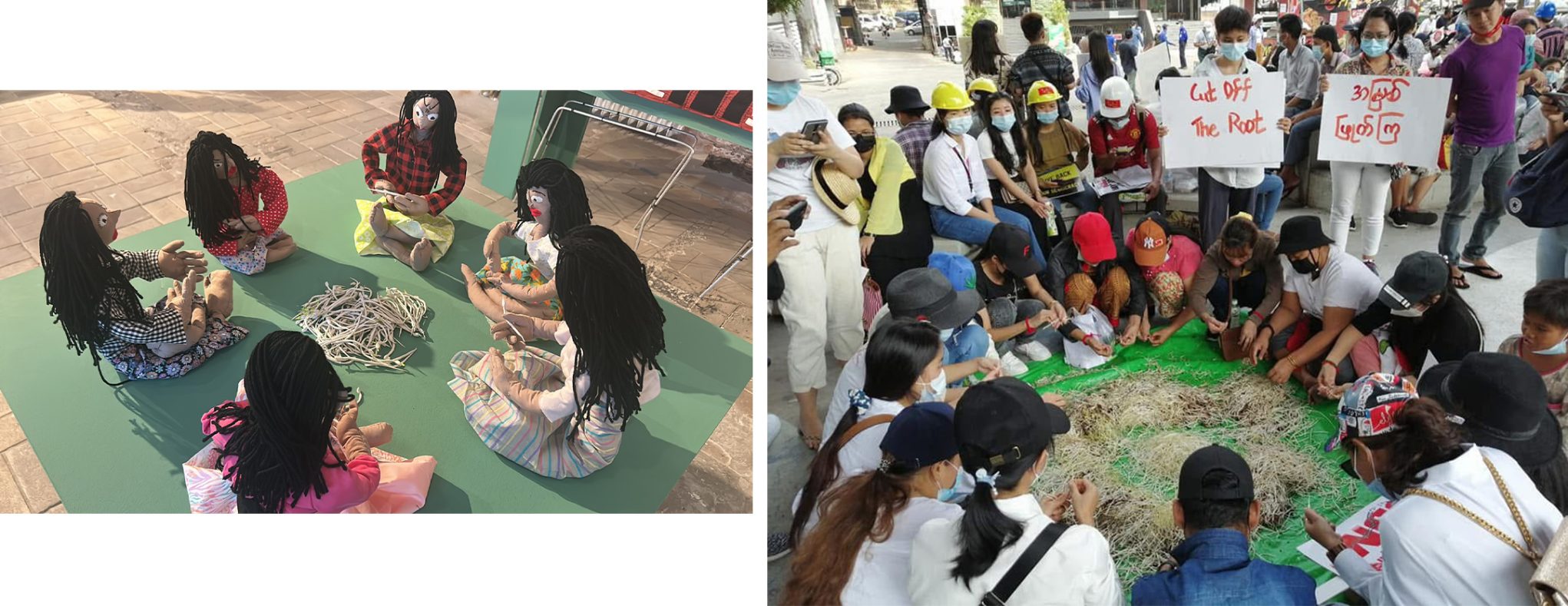
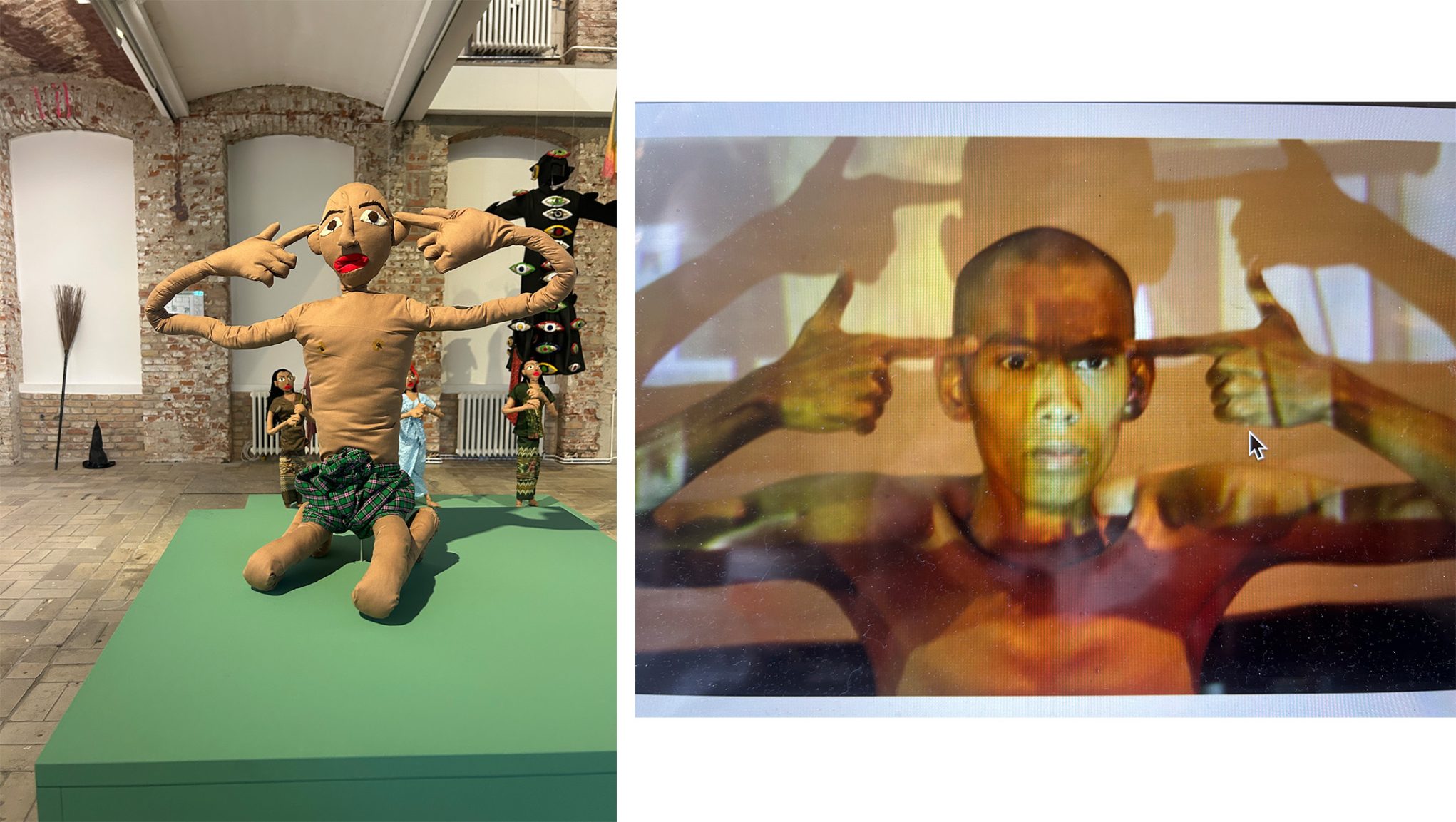
The soft sculptures created for the 2025 Berlin Biennale were based on performance art I’ve witnessed throughout my life – performances made by artists in exile, made in hiding, or made by artists who cannot perform at the present time. I wanted to bring those artists and artworks with me, through my soft sculptures, to tell the history of Burmese performance art. So focusing on the time frame from 1996 to 2021, the year of the military coup, I created 14 performance works, resulting in 38 soft sculptures, which in Berlin cover a whole floor.
The Berlin work is one of my most ambitious works to date. It is based on research and transforms performance art, protest history, and collective memory into a sculptural environment, reimagining decades of artistic resistance in Myanmar. In my mind, soft materials, while they might initially appear fragile, in this work they become a language of resilience. This work also takes the form of a monument made of care, labor, memory, community, stories, and solidarity that can travel across borders and continue to generate political and cultural energy.
So shipping was just one of the reasons I switched to soft sculpture. For example, shipping clay sculptures would have cost many thousands of dollars one way. But by using fabric, I was able to pack everything into three suitcases, costing a few hundred dollars one way.
Jen & Ravina:
As you continue working, what are some questions you are asking yourself? What are you interested in exploring?
Chaw Ei:
I want to continue this project, not only with Burmese performance artists, but also with international performance artists. Performance artists do not get enough acknowledgement. I want to honor artists who never receive recognition. I want the audience to understand what performance art is—its sacrifice and resilience. I also look forward to doing more research and watching more performances in person.
Interviews are something I also intend to continue. Every week, I meet with Burmese performance artists in exile. I encourage them. Many are frustrated, and some depressed because of language barriers, document requirements, travel restrictions, and difficulty finding jobs. These artists in exile were often well established in their home country, but they are unknown abroad. Some are so desperate that they are even thinking about ending their lives.
I am hoping my artwork will support and encourage them, by highlighting what they have done. This is very important.
Jen & Ravina:
That’s beautiful. Thank you so much for sharing.
Chaw Ei:
My pleasure. I have enjoyed sharing my work with you and always like working with AAA.
Date of interview: 11/20/2025
Edited by Jane DeBevoise July 2026
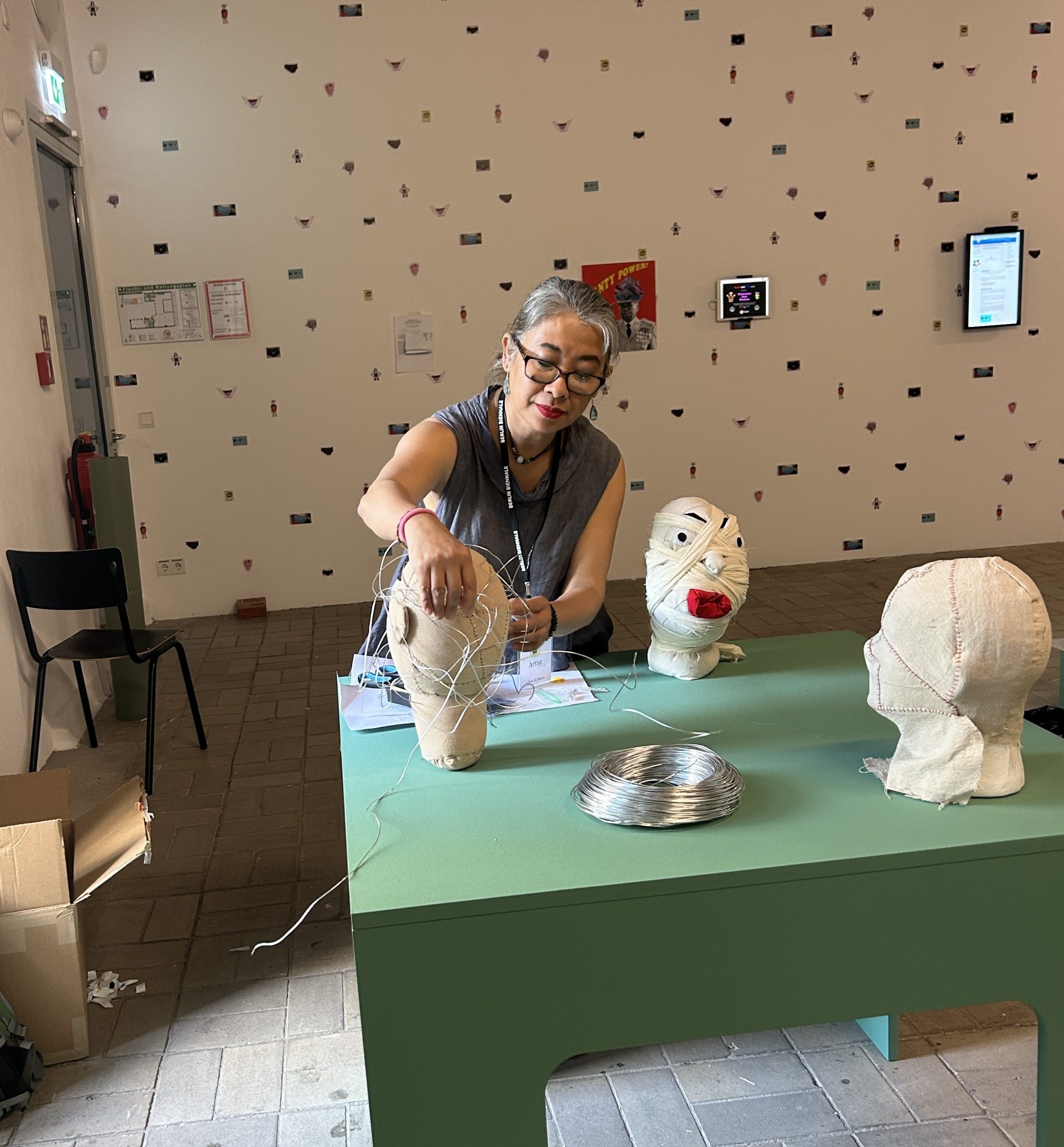
Chaw Ei Thein is a Burmese painter and performance artist currently living in Austin, Texas. Originally trained in law, she turned to art under the influence of her father, painter Pathein Maung Maung Thein. Her work often addresses socio-political conditions in Myanmar and uses the body as a site of resistance and memory. From early performances in Myanmar that quietly resisted military rule to international exhibitions and residencies, her work centers the body as a site of memory, protest, and survival. After relocating to the United States, she continues to address the realities of exile, while remaining connected to Myanmar’s artistic community.
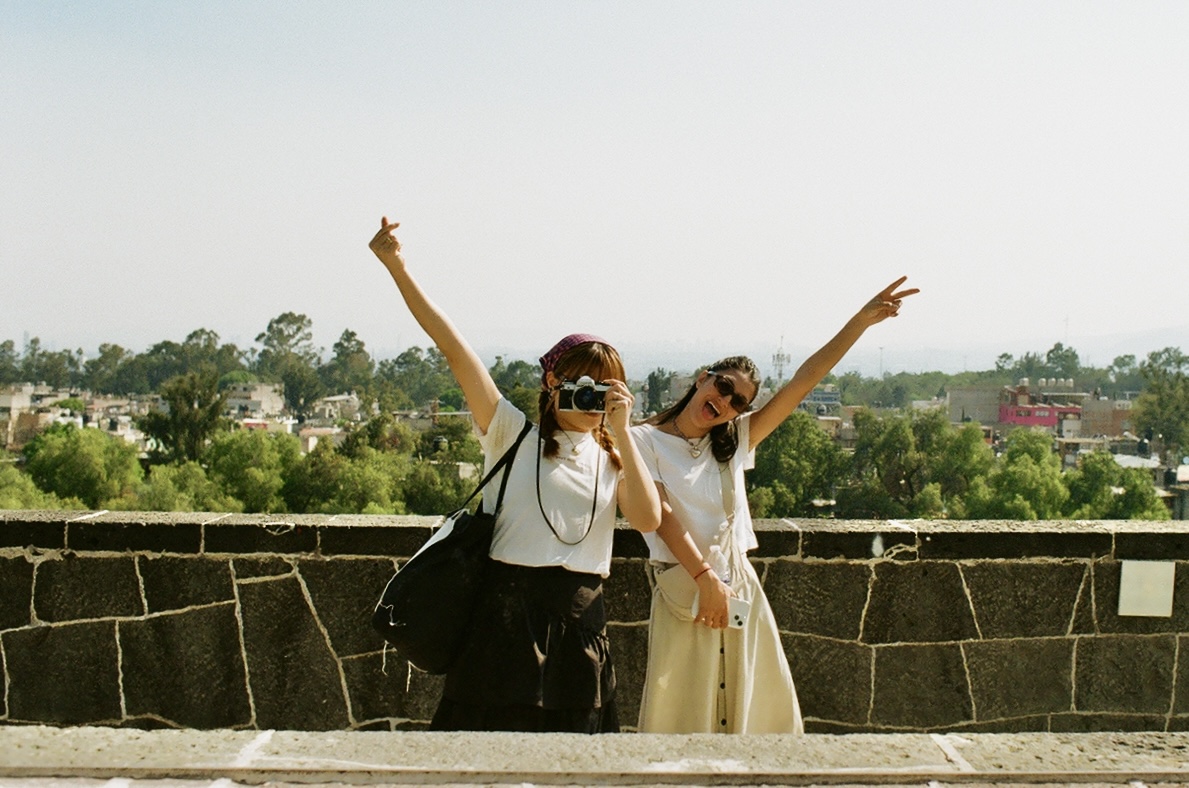
Jen Louie and Ravina Jain are Digital Archive Fellows at Asia Art Archive in America. Through their collaborative work, they explore artists’ archives in order to trace how individual histories shape artistic practice and cultural narratives, with the aim of amplifying underrepresented perspectives through research, writing, and visual documentation. They also document their process on @11_to_2, a platform dedicated to their ongoing explorations.