Talk
Comics for the Revolution: Lianhuanhua in China 1949-1989 Transcript
October 2, 2026 – October 2, 2026
Asia Art Archive in America
23 Cranberry St. Brooklyn, NY
The following is a transcript of a program that took place on May 26, 2026 at Asia Art Archive in America. For more information, please see the original program webpage here.
Jane DeBevoise: Welcome everyone. We are delighted to see you all here, especially our esteemed guests, Professors Zheng Shengtian and Kuiyi Shen, whom I will introduce in a moment. I would like to begin with an introduction to the subject of today’s presentation.
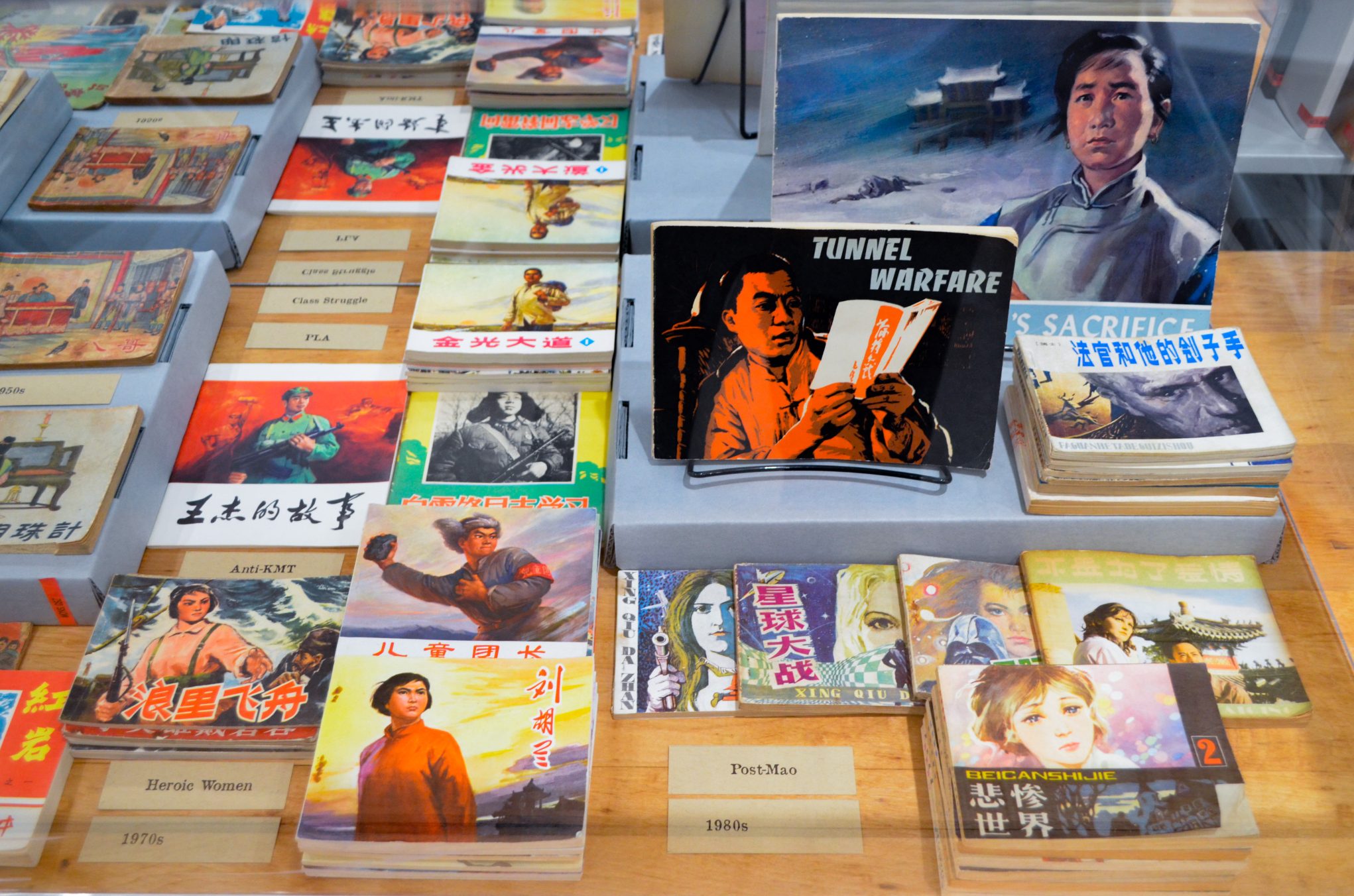
Lianhuanhua 连环画 are small, palm-sized books, or booklets, that emerged in China as a popular form of entertainment, much like comic books, toward the end of the Qing dynasty [1644–1912]. In the 1920s, at the beginning of the Republican era, these booklets were given the name lianhuanhua, which translates literally as “serial picture books” or “serially linked pictures.”
In 1949, with the establishment of the People’s Republic of China, Mao Zedong mandated that all art, including comics—and thus, by extension, lianhuanhua—should serve the people. So, these cute, popular picture books were transformed into widely published, widely circulated platforms for the dissemination of Maoist thought. This was between 1949 and 1976. Stories included tirades against the inept Guomindang and celebrations of the heroic People’s Liberation Army. There were a lot of villains in these stories—landlords and capitalists—but also a lot of heroes, for example, good Communist soldiers, factory workers, and peasants, who were oftentimes women. Which is one of the reasons that I was drawn to lianhuanhua when I first encountered them, as a young woman myself.
In 1976, Mao Zedong died and the Cultural Revolution ended, and these little books quickly returned to their original function as popular entertainment. They were again published in the hundreds of millions and disseminated throughout China at a time when most of the population was still poor, and forms of popular entertainment were limited. Few people owned televisions or stereos, and of course, there was no internet or social media. At the same time, previously banned forms of Western popular culture began to seep in, including sci-fi, love stories, and more. These external influences were introduced at the same time as a resurgence of traditional Chinese folk tales. Lianhuanhua published it all—Star Wars in particular was a hit! But by the end of the 1980s, lianhuanhua had decreased in popularity and were being published in smaller and smaller numbers, replaced by a more seductive and technologically advanced form of pop culture: television soap operas and, some would argue, Japanese-style manga cartoons. China’s economic rise had begun.
Here to speak about this distinctive form of Chinese visual culture are Professors Kuiyi Shen and Zheng Shengtian.
Kuiyi Shen is an art historian and professor of art history at the University of California San Diego. He has done extensive research and, along with his partner and wife, Professor Judy Andrews, has curated exhibitions about lianhuanhua. In addition to being leading historians of Chinese art, Shen and Andrews co-curated the modern section of the watershed exhibition China: 5,000 Years that was presented at the Guggenheim New York in 1998 before traveling to the Guggenheim Bilbao that same year. Professor Shen will provide an introduction to and an overview of lianhuanhua from an art-historical perspective.
Our second speaker is Zheng Shengtian. We are thrilled to have him here. Incredibly, he and I have been talking about organizing this sort of program for well over ten years. I think the very first time we talked about lianhuanhua was at a restaurant in Shanghai. Someone at the table started asking simple questions, and out came a stream of amazing answers. That was probably in the early 2000s, and here we are now in 2026. I am so glad that we are finally able to do this.
Zheng Shengtian’s life bears witness to the fascinating arc of China’s recent history. Born before the revolution, Professor Zheng studied at one of the most prestigious art academies in China, variously called the Hangzhou Academy, the Zhejiang Art Academy, and, now, the China National Art Academy. Upon graduating, he stayed on as a teacher, during which time he experienced the turmoil of the strictest Maoist period. His career has had some ups and downs, shall we say! But in the late 1970s, after Mao died and those who had not toed the Maoist line were rehabilitated and returned to positions of authority, Zheng Shengtian was appointed the head of the oil painting department at this highly prestigious institution. He went on to become the mentor and teacher of some of the most important avant-garde artists to come out of China: Wang Guangyi, Zhang Peili, Geng Jianyi, Huang Yong Ping, and many others. The late 1970s and 1980s was a special moment in the trajectory of Chinese art, when certain leading figures, including Professor Zheng, were willing to take a chance on emerging artists who were pursuing interesting new directions in art. These formerly criticized Rightists not only tolerated the new guard but encouraged their innovations. So, in many ways Professor Zheng can be considered the godfather of contemporary art in China.
Zheng Shengtian left China in the late 1980s and settled in Vancouver, where he founded and is still the managing editor of Yishu, the only English-language journal dedicated to contemporary Chinese art. He has also been an adviser to multiple institutions, curated numerous exhibitions, and continues to write, including a recently published book on Mexican muralists who traveled to China in the 1950s and ’60s and influenced the development of Chinese art at the time.
Now, let’s welcome Professor Kuiyi Shen.
Kuiyi Shen: Thank you, Jane, for that introduction.
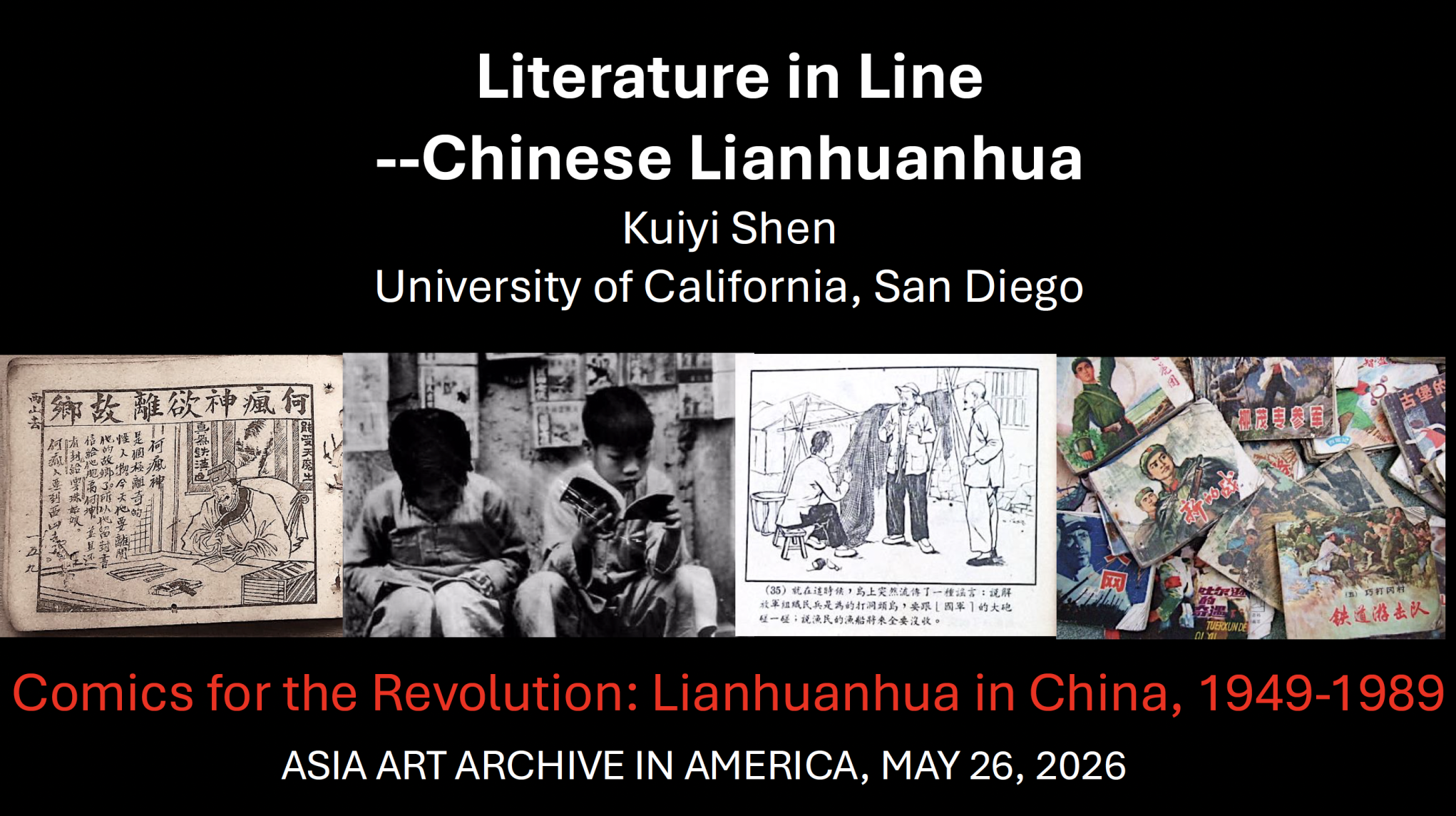
Lianhuanhua (serial picture books) emerged as a popular form of printed entertainment in Shanghai in the early twentieth century, developing closely in tandem with the publishing industry. Although lithography had been in practice in China since the late nineteenth century, lianhuanhua and another distinctive genre of serialized lithographic illustration, comic books, were embraced with particular enthusiasm by the Chinese public in the 1920s and 1930s, enjoying decades of popularity. The contents, styles, production methods, and distribution systems of these two popular genres reflected the different tastes of contemporary social groups in China’s major metropolis at that time, Shanghai.
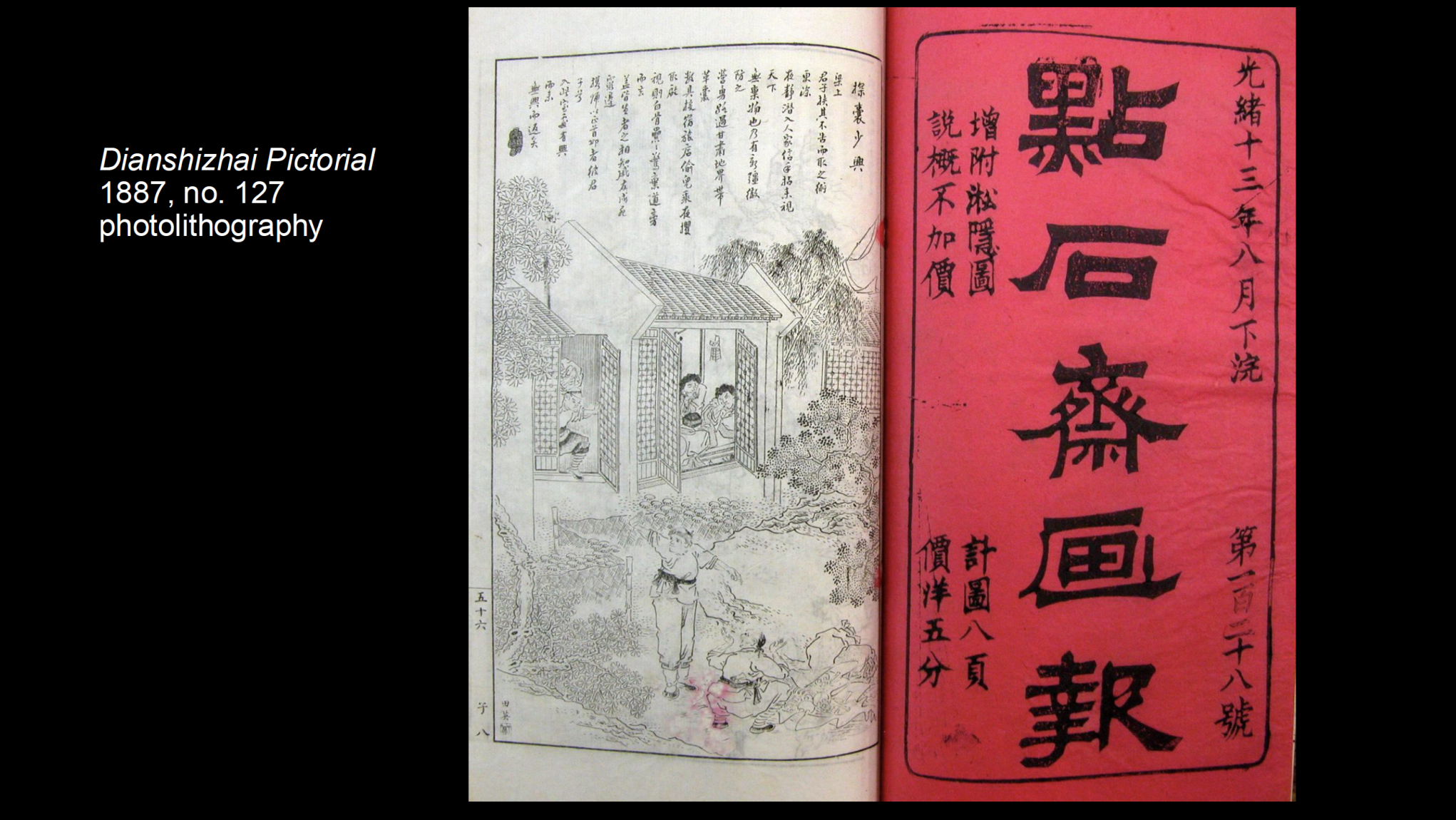
An embryonic form of lianhuan tuhua (連環圖畫), as the genre was originally known, appeared in the late nineteenth century, after lithographic printing was introduced to Shanghai from the West. The editors of the magazine Dianshizhai Pictorial 點石齋畫報 (Dianshizhai huabao) made use of this new technology to reproduce line illustrations and calligraphic texts that appealed to the tastes of Chinese readers. The technique brought new possibilities to the Chinese illustrated press, as it was cost-effective and efficient, permitting streamlined—and thus increased—production. Following the revolution of 1911, popular literature in the form of newspapers, magazines, and booklets emerged with ever increasing regularity. Lithography was soon joined by other new printing processes from Europe and the United States, which appeared successively in Shanghai and then in other urban centers across China. The result was an even wider distribution of pictorial literature, which swiftly became a cultural product increasingly sought after by the public.
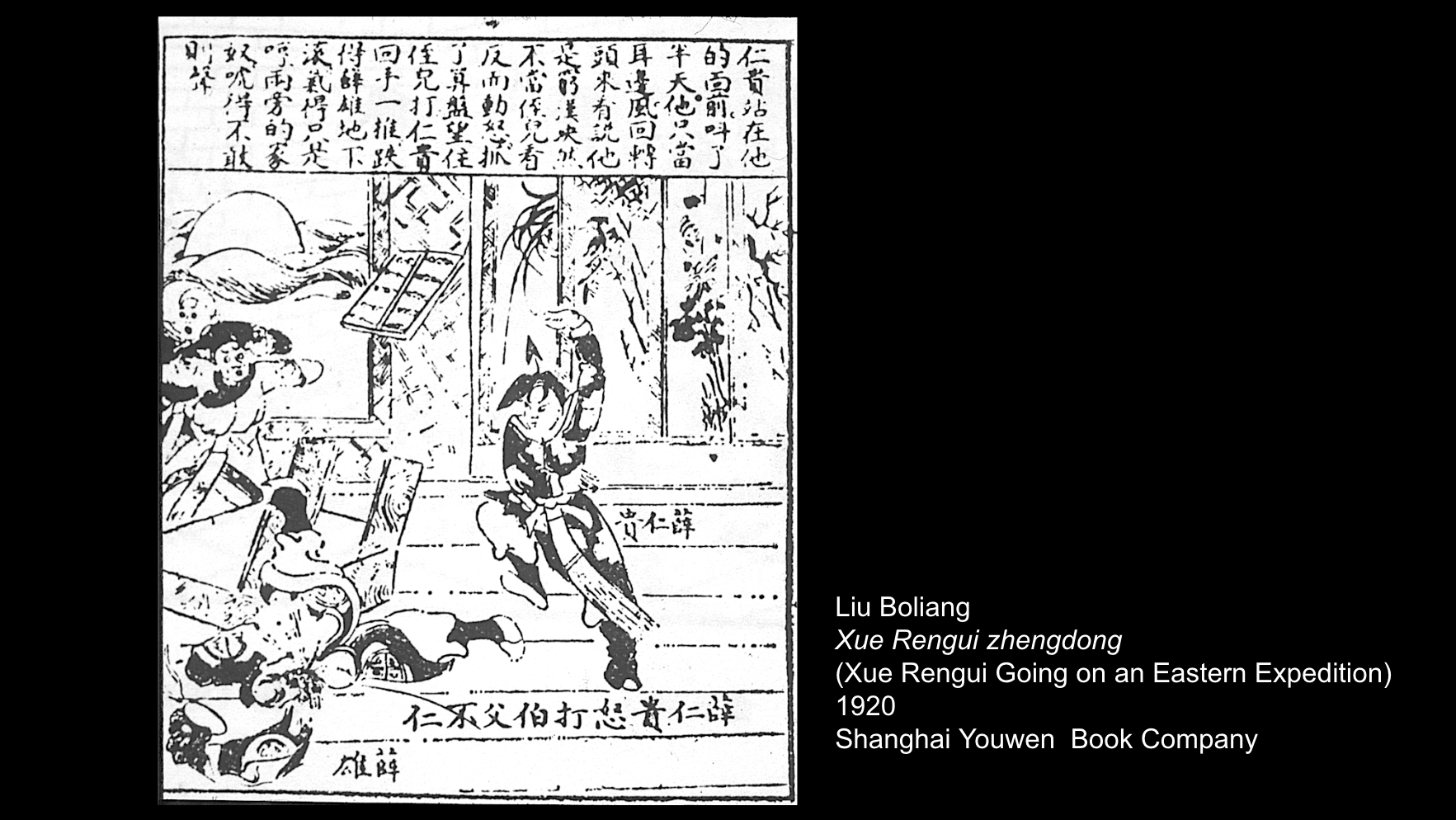
The narratives we now call lianhuanhua are similar to comic strips. The term “lianhuanhua” was not used to describe them until 1927. Before that time, this kind of small illustrated booklet was referred to by various names, depending on the region: Little Book 小書 (xiaoshu) or Picture Book 圖畫書 (tuhuashu) in Shanghai; Kid’s Book 公仔書 (gongzaishu) in Guangzhou; Children’s Book 伢伢書 (yaya shu) in Wuhan; kid’s book 小人書 (xiaorenshu) in the north. With time, the themes of these storybooks were expanded to encompass popular literature and current social events. The earliest example might be Xue Rengui Goes on an Eastern Expedition 薛仁貴征東 (Xue Rengui zhengdong), which was based on the novel of the same title published by Youwen Book Company 有文書局 in 1920. The illustrations were painted by Liu Boliang 劉伯良, whose style would be adopted by most lianhuanhua illustrators for the next decade.
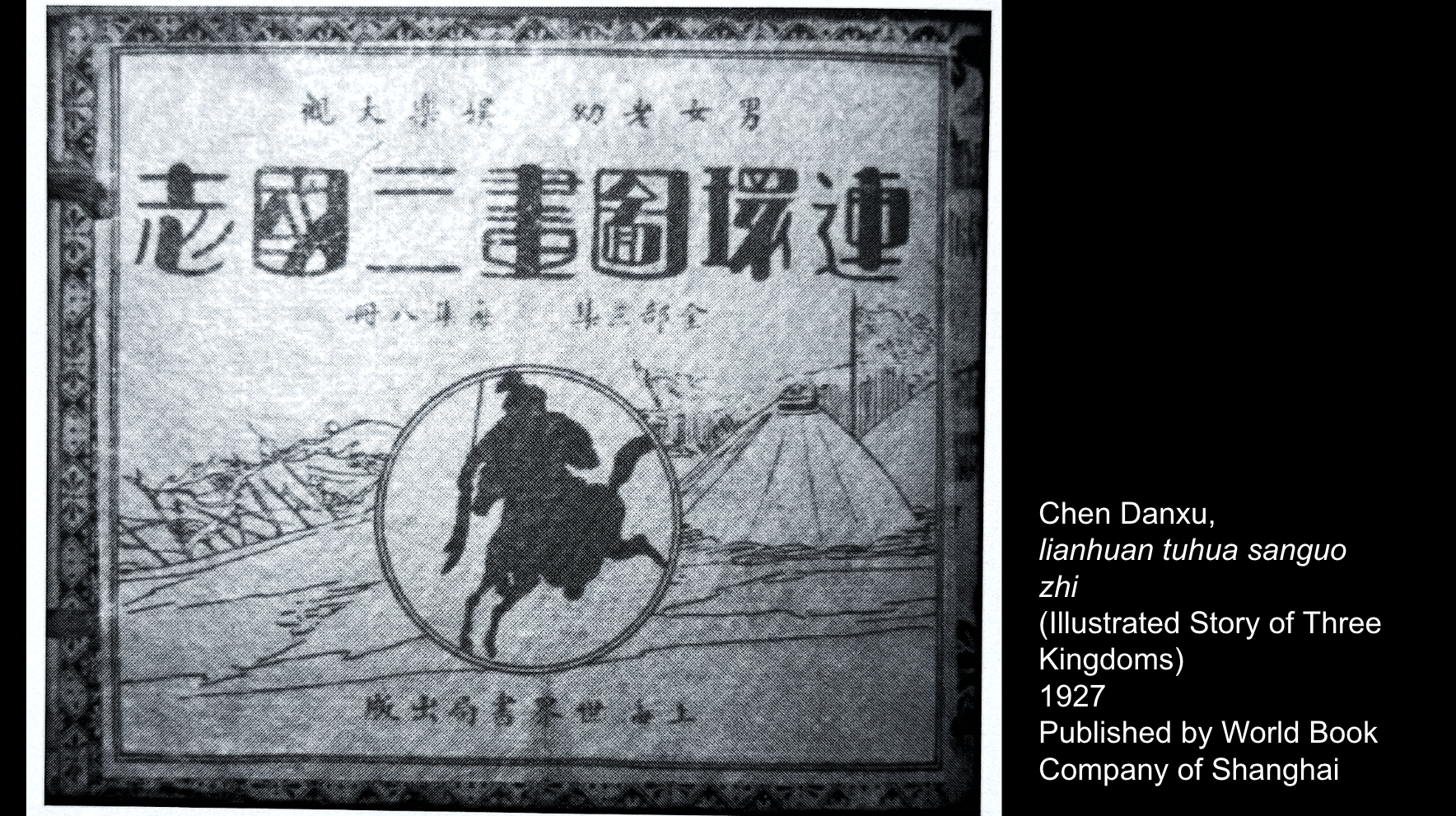
The growing market for lianhuanhua gradually drew the attention of bigger publishers. In 1927, World Book Company 世界書局, which had been established in 1921 in Shanghai, published History of Three Kingdoms 三國志 (Sanguo zhi), one of the most popular novels in China. It was transformed into a picture book by Chen Danxu 陳丹旭, under the title Illustrated History of Three Kingdoms 連環圖畫三國志 (Lianhuan tuhua sanguo zhi). We see here the first use of the term “lianhuan tuhua,” which has since become the standard way of referring to this kind of picture book. (With time, the character 圖 tu was omitted, and the books came to be known simply as lianhuanhua.)
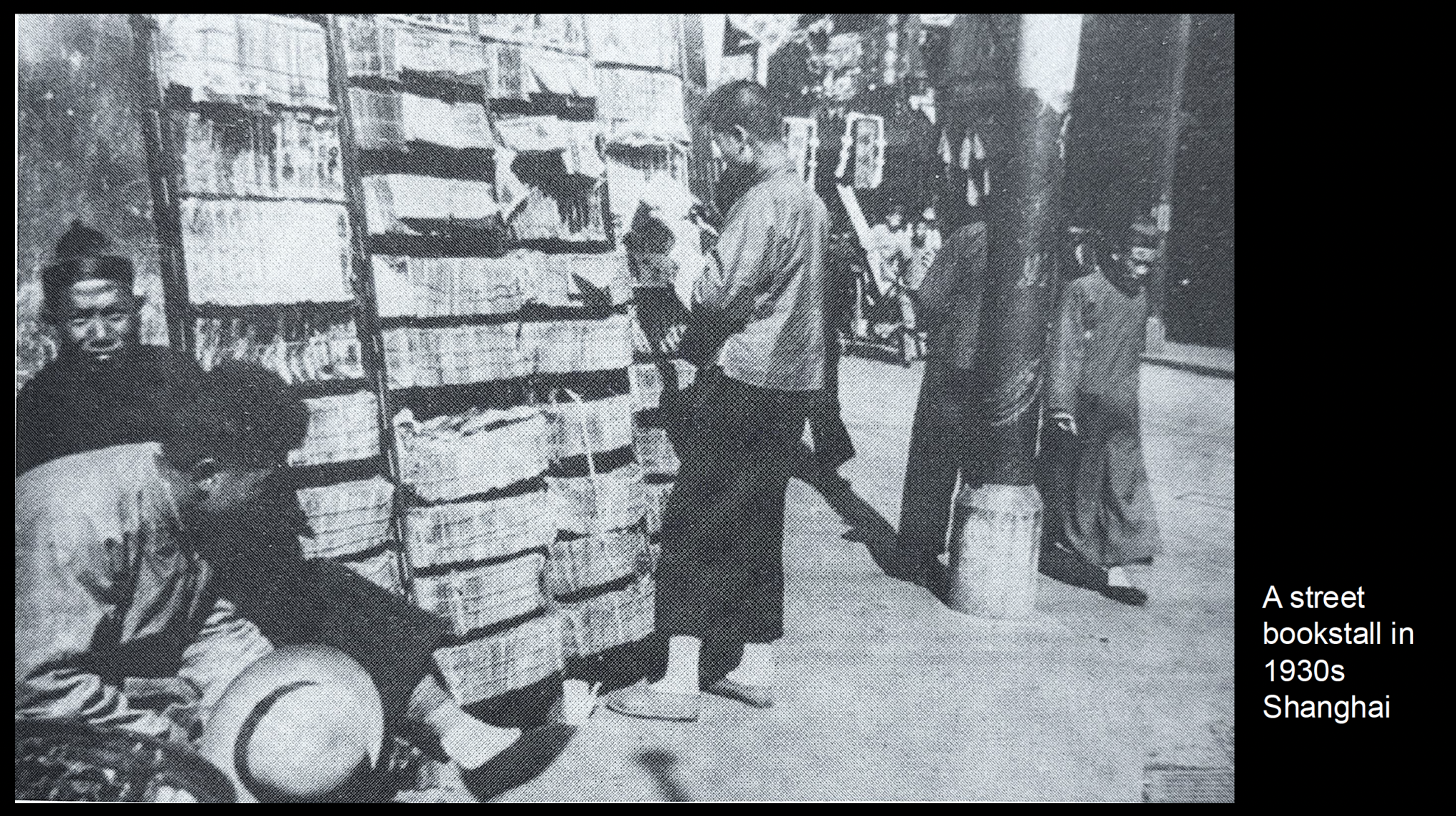
Their swift rise in popularity is attributable in part to the unique system by which they were distributed. Because their themes encompassed popular dramas and often wild legends and stories, lianhuanhua were considered vulgar or “lowbrow” by intellectuals, and most bookstores did not want to sell them. However, they did attract readers from other groups of society, including children and those with less education. These readers represented a distinct and robust market, and a unique distribution network developed in Shanghai to cater to it: Publishers sold lianhuanhua directly to streetside bookstalls, which in most cases did not sell the booklets but rented them to people who either did not have enough money to buy a book or preferred to spend just a few “nickels and dimes” to read more. During the 1920s and early 1930s, most small publishers in Shanghai that produced lianhuanhua were located on a street called Beigongyili, in the Zhabei district. Every night, bookstall owners would buy newly published and popular illustrated serials directly from these publishers. At that time, two new volumes of each serial went to market each night, most issued in quantities of more than two thousand copies. Typically, after twenty-four volumes of the serial were issued, publishers bound them together and packaged them in a box, similar to old-style books.
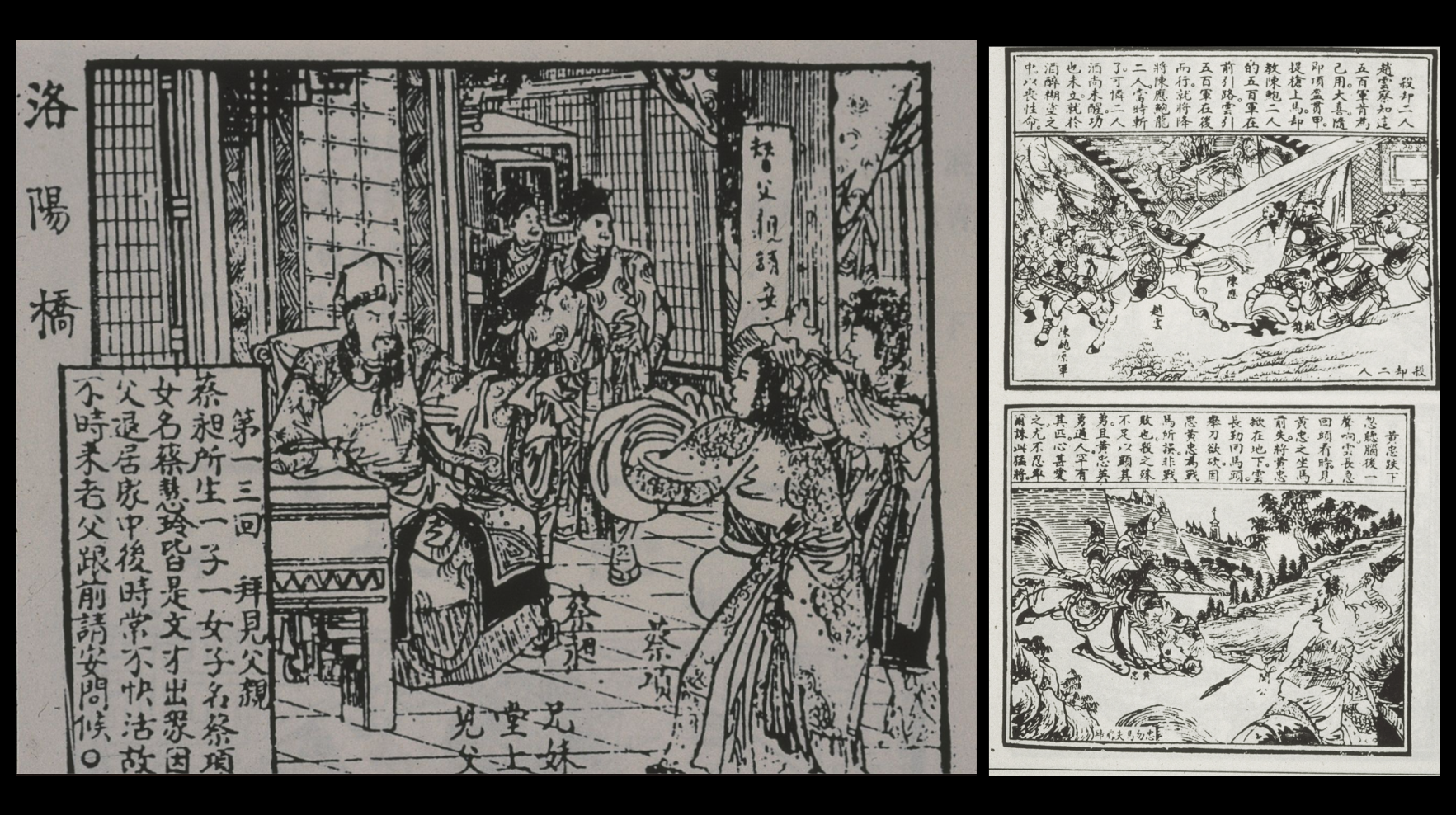
This unique system of distribution developed quickly and gave rise to an equally unique system of production. In addition to the World Book Company and a few other big publishers, there were about twenty smaller publishers that released illustrated serials, and in the 1920s and 1930s, there were no more than ten professional cartoonists working for them. Each publisher usually commissioned one or two cartoonists to supply illustrations. The work, however, was not done by a single artist but by a kind of traditional workshop, with each cartoonist usually having several disciples working under him. (This master-disciple system would continue in cartoonists’ circles until the early 1950s.) Owing to the specialized nature of the lianhuanhua market and its distribution system, speed of production was crucial. Publishers usually required artists to hand in finished works every day. So, when a master cartoonist received a commission, he would determine the overall compositions and draw the main images, then let his disciples fill in the details, such as architecture, rocks and trees, animals and flowers, and even the patterns and motifs of the clothes.
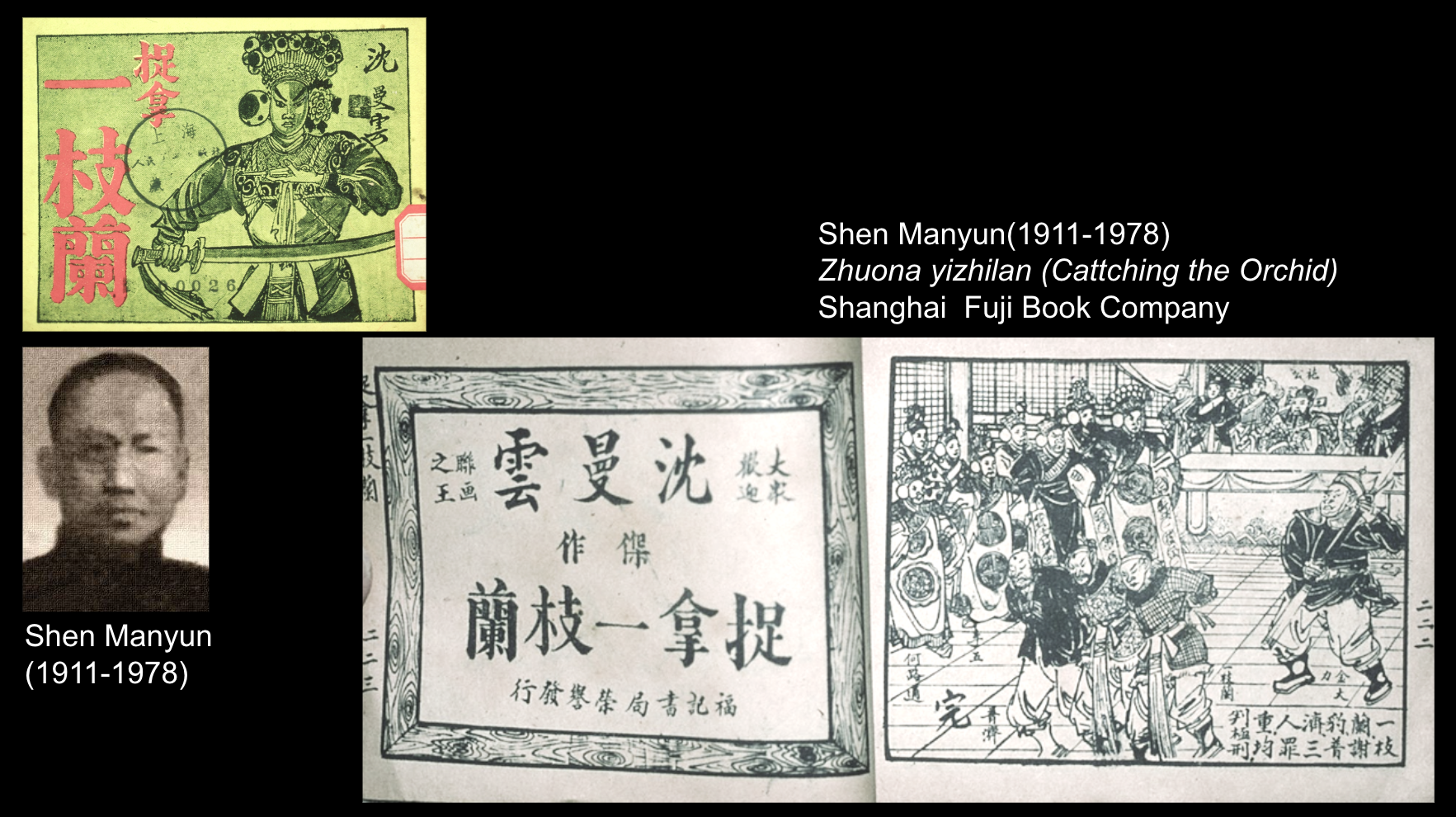
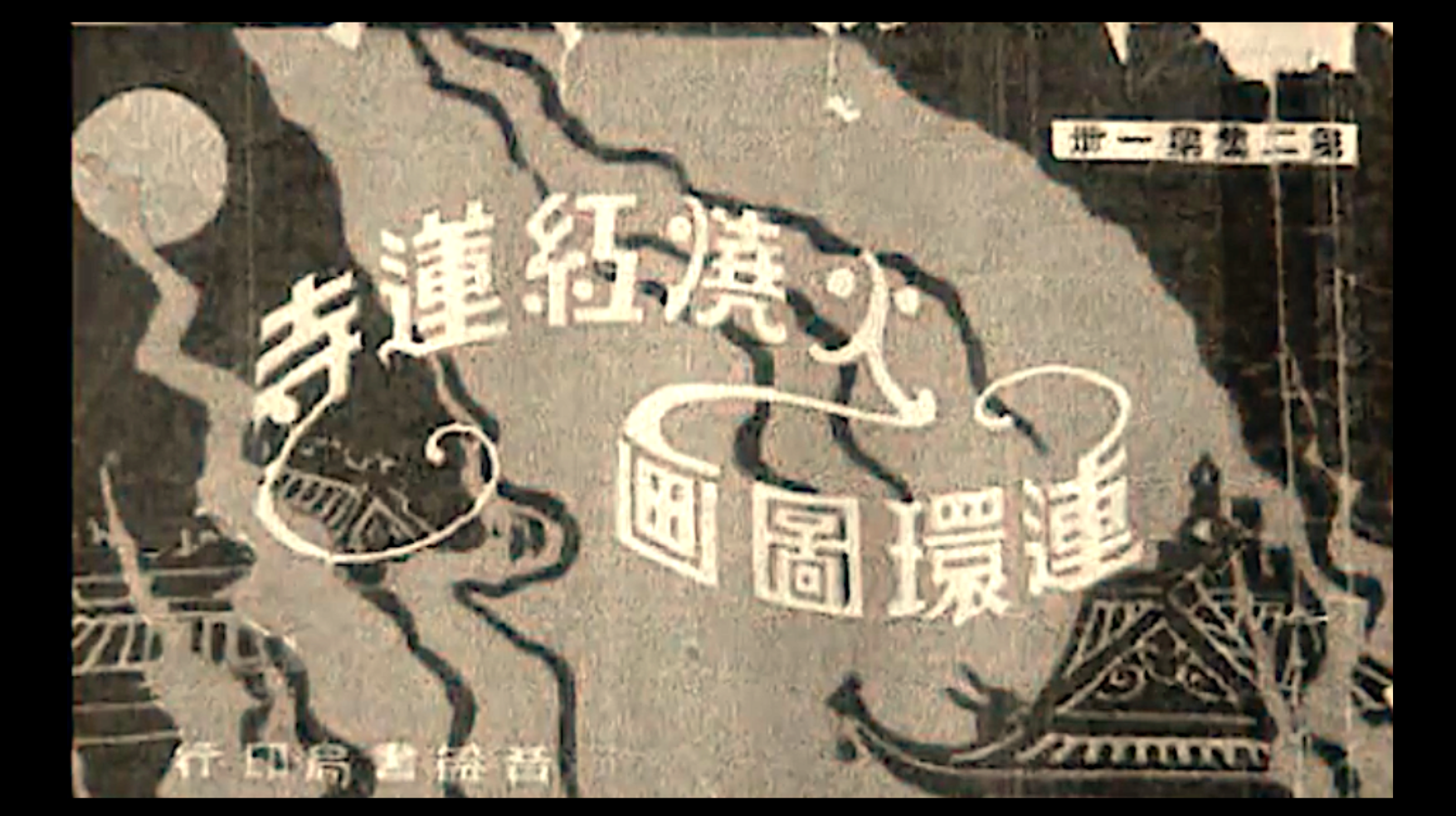
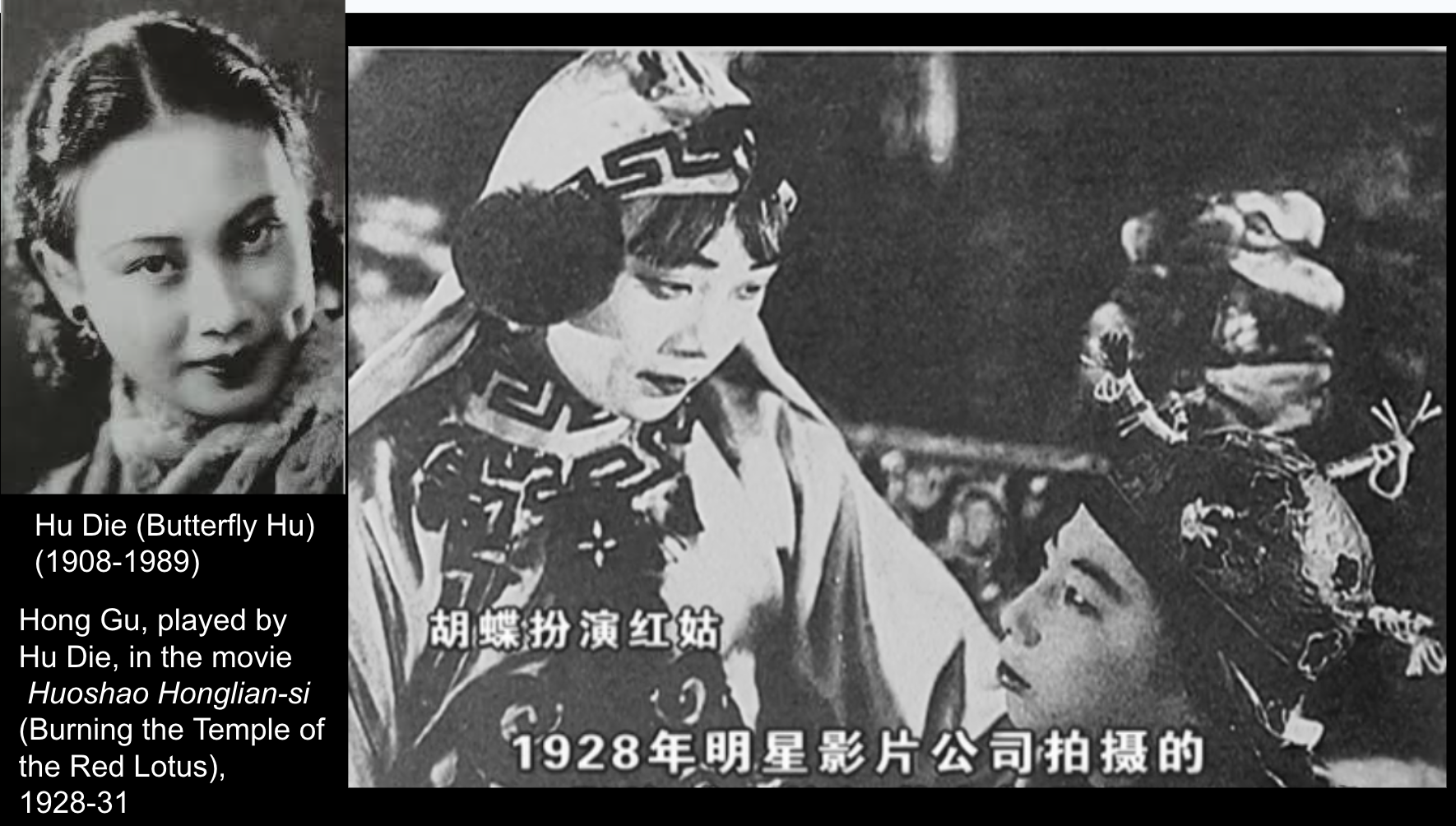
Lianhuanhua often reproduced the plots and characters of the latest theatrical productions and films. Among the most popular was a series of about twenty movies made under the title Burning the Temple of the Red Lotus 火燒紅蓮寺 (Huoshao hongliansi), realized between 1928 and 1931. Hu Die 胡蝶 (Butterfly Hu), one of the most famous Chinese actresses of the era, played the main character in these films. They were so successful that they were immediately made into lianhuanhua—unfortunately, however, with a rapidity that jeopardized artistic quality. Nevertheless, from this point onward, film, along with theater, became one of the main sources for lianhuanhua, allowing the public in big cities to read and view repeatedly the achievements of its favorite heroes. And for those who did not yet have access to movies, lianhuanhua became the primary means of experiencing these popular stories.
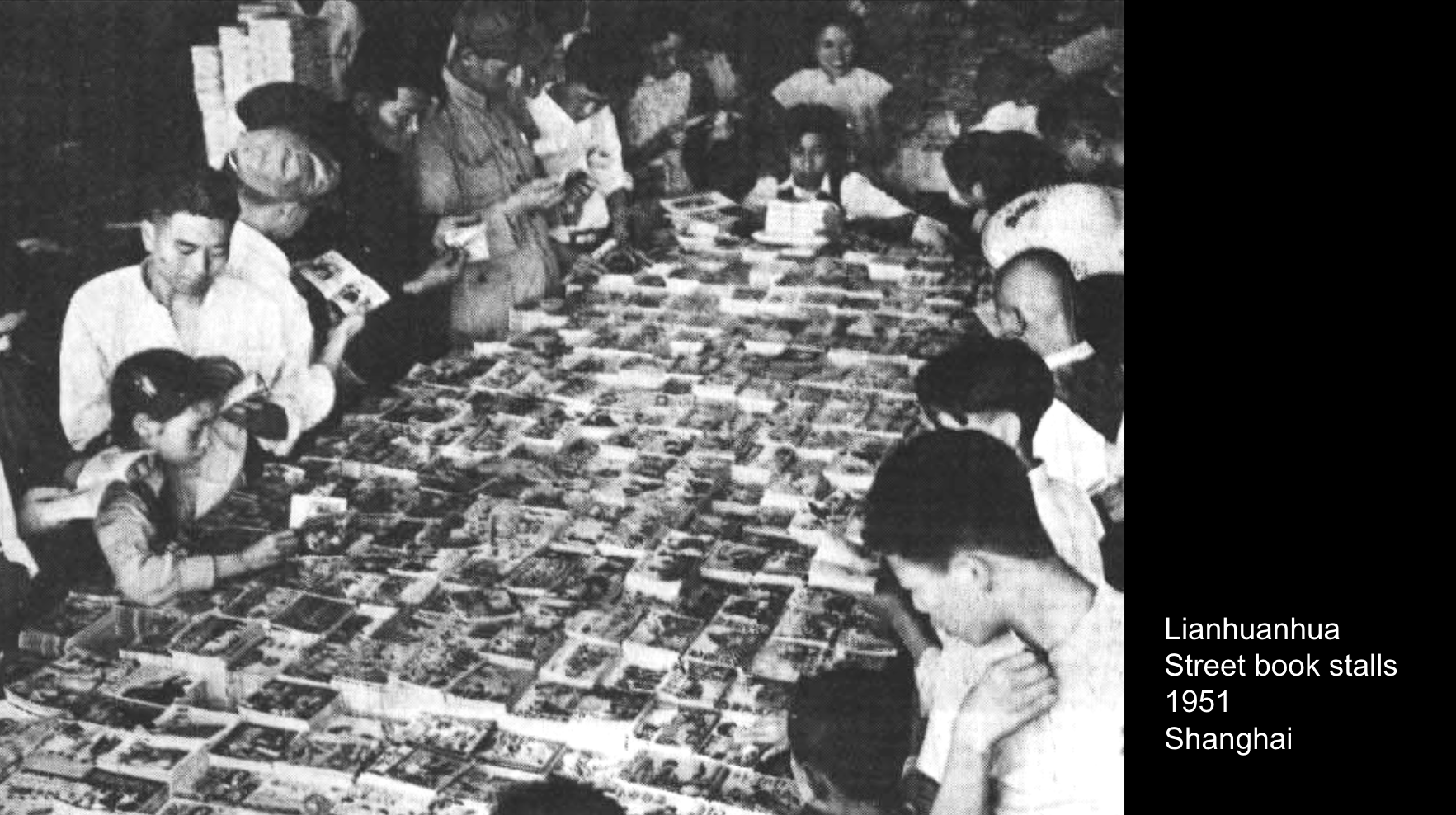
By the end of the 1940s, the industry had grown considerably: There were more than thirty established professional lianhuanhua artists, more than one hundred publishers, and more than two thousand street bookstalls in Shanghai, and distribution networks had expanded to Hong Kong, Singapore, and Indonesia, creating a new market for commercial art among lower-class consumers. After 1949, however, lianhuanhua became a core part of the Maoist artistic agenda and underwent radical transformations in response to the sometimes contending trends of socialist realism and cultural nationalism.
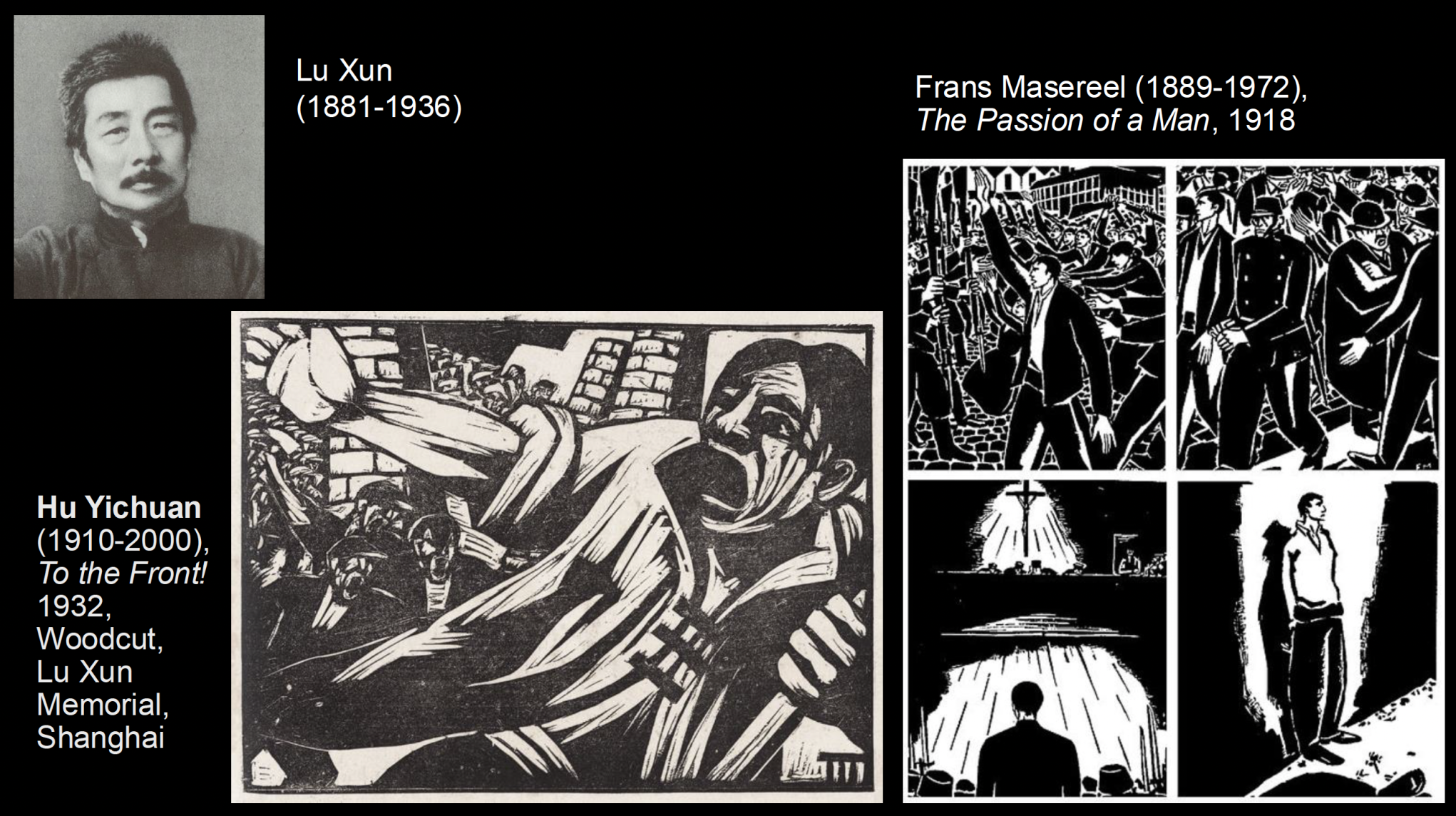
As early as the 1930s, lianhuanhua, together with woodblock prints, were strongly promoted by Lu Xun 魯迅, a leading figure of modern Chinese literature and advocate of mass culture, for the power of their expressive language and for the potential their reproducibility provided to disseminate new ways of thinking. Both genres were adopted as revolutionary arts in the Communist territory of Yan’an during wartime and further developed after 1949 under Communist direction, with lianhuanhua being strongly promoted as part of the effort to popularize ideology through art. In 1952, with the establishment of the New Art Press 新美术出版社 of Shanghai, a forerunner of the state-owned Shanghai People’s Fine Arts Publishing House 上海人民美术出版社, more than a dozen small lianhuanhua publishers were consolidated. By 1953, 6,490 separate titles were published.
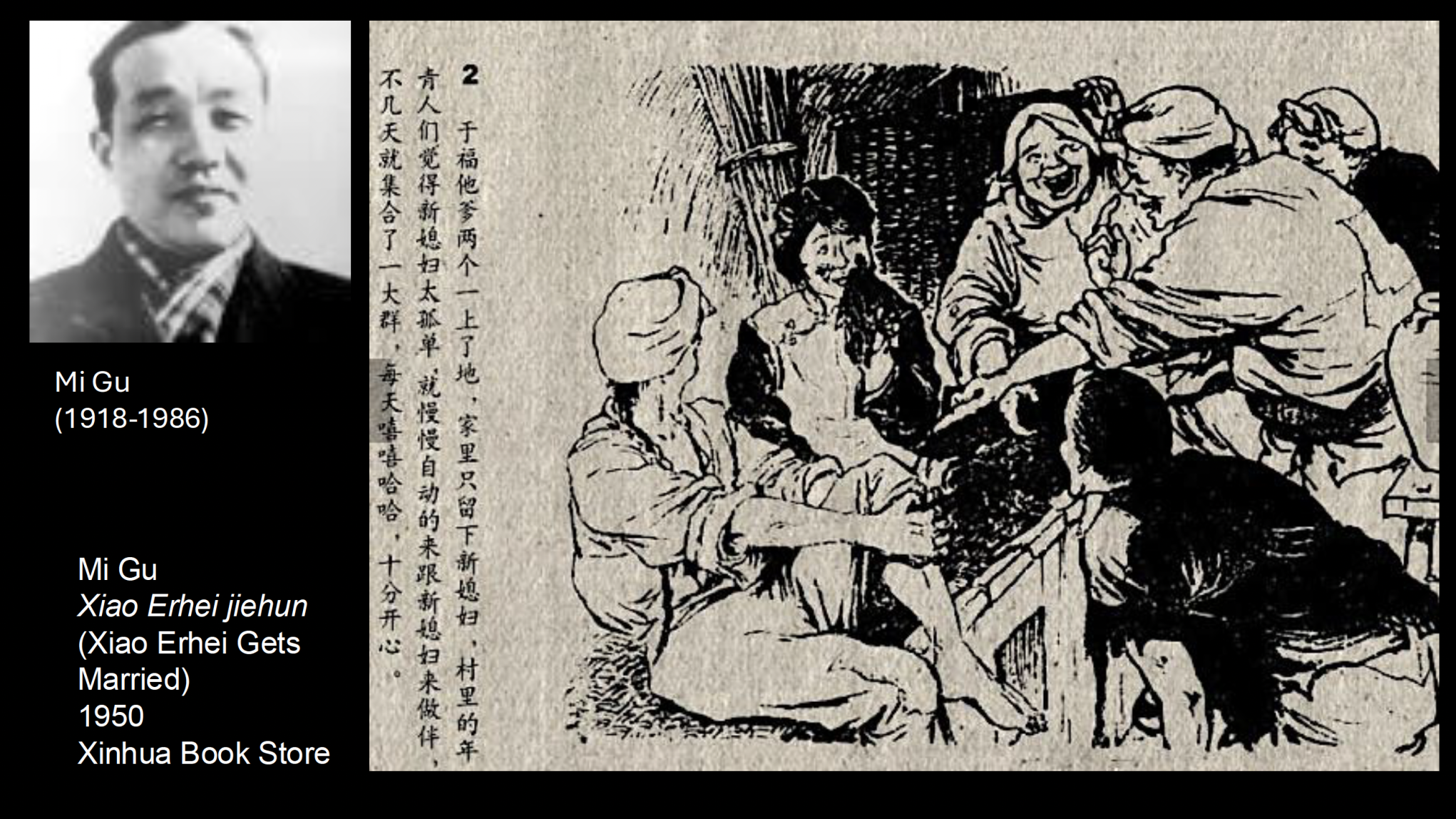
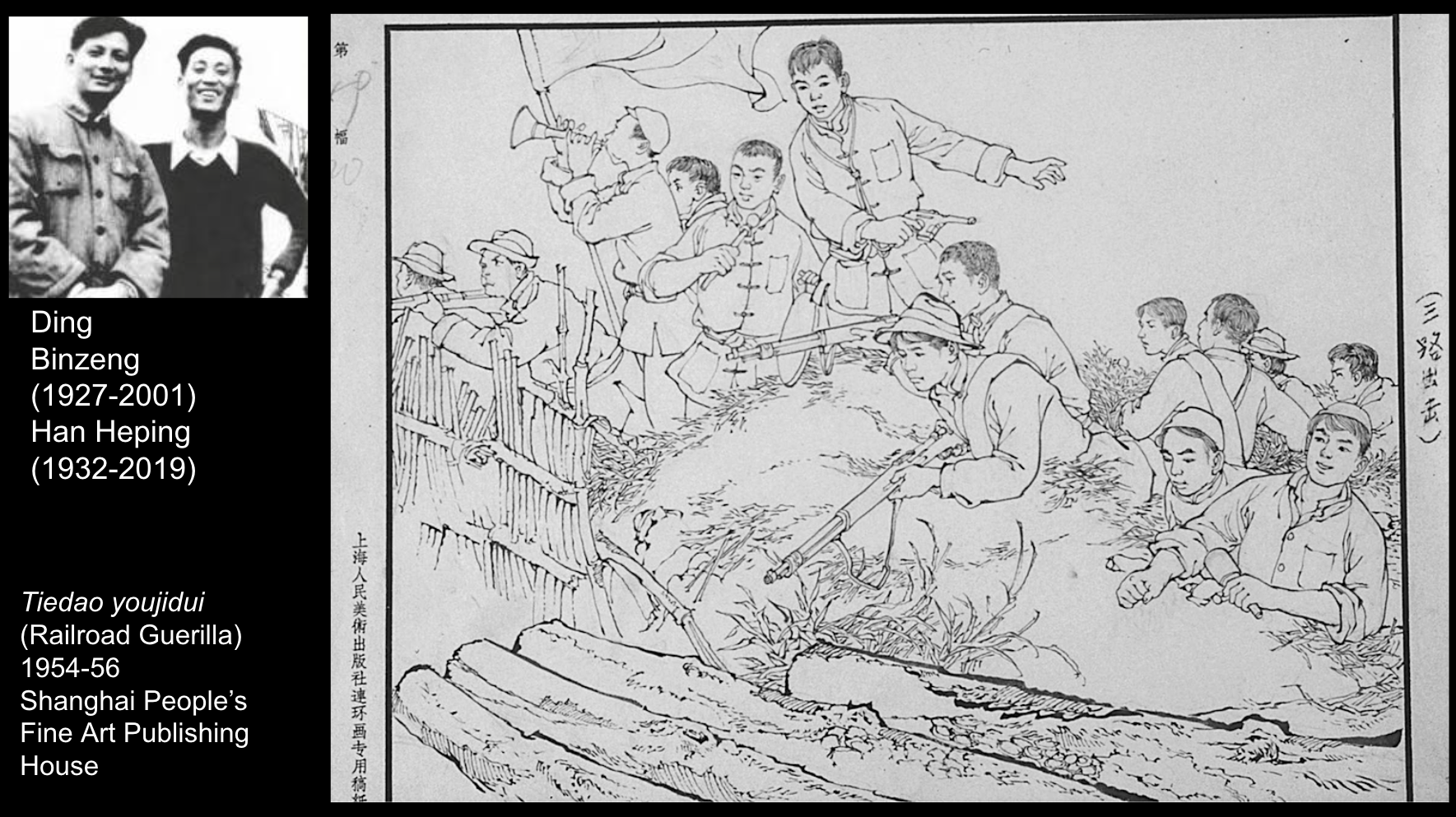
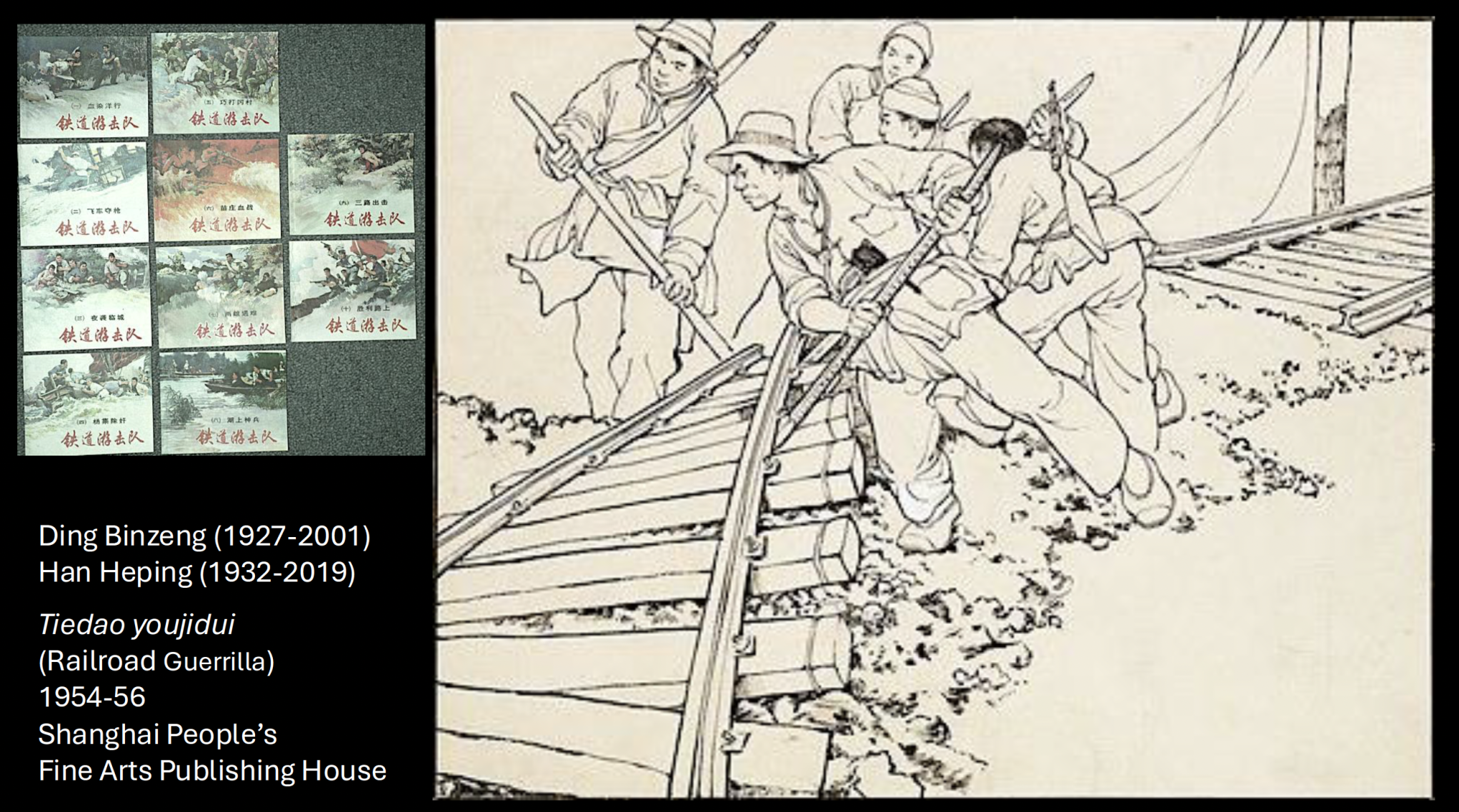
Among the new lianhuanhua considered to be a success in the early 1950s was Xiao Erhei Gets Married 小二黑結婚 (Xiao Erhei jiehun), a rather turgid tale that discouraged arranged marriages in favor of freely choosing one’s spouse. The plot and text were based on a propaganda play performed for peasants in the Communist areas of northern China during the war. Railroad Guerillas 鐵道游擊隊 (Tiedao youjidui), a more entertaining and much more skillfully drawn lianhuanhua about secretly sabotaging Japanese-controlled railways in Shandong during World War II, began publication in 1954. The sales of this ten-volume war story exceeded four million copies in the course of more than thirty-five reprintings. Its illustrations were rendered in the outline manner, and were thus well-suited for inexpensive, mass-market publication worldwide.
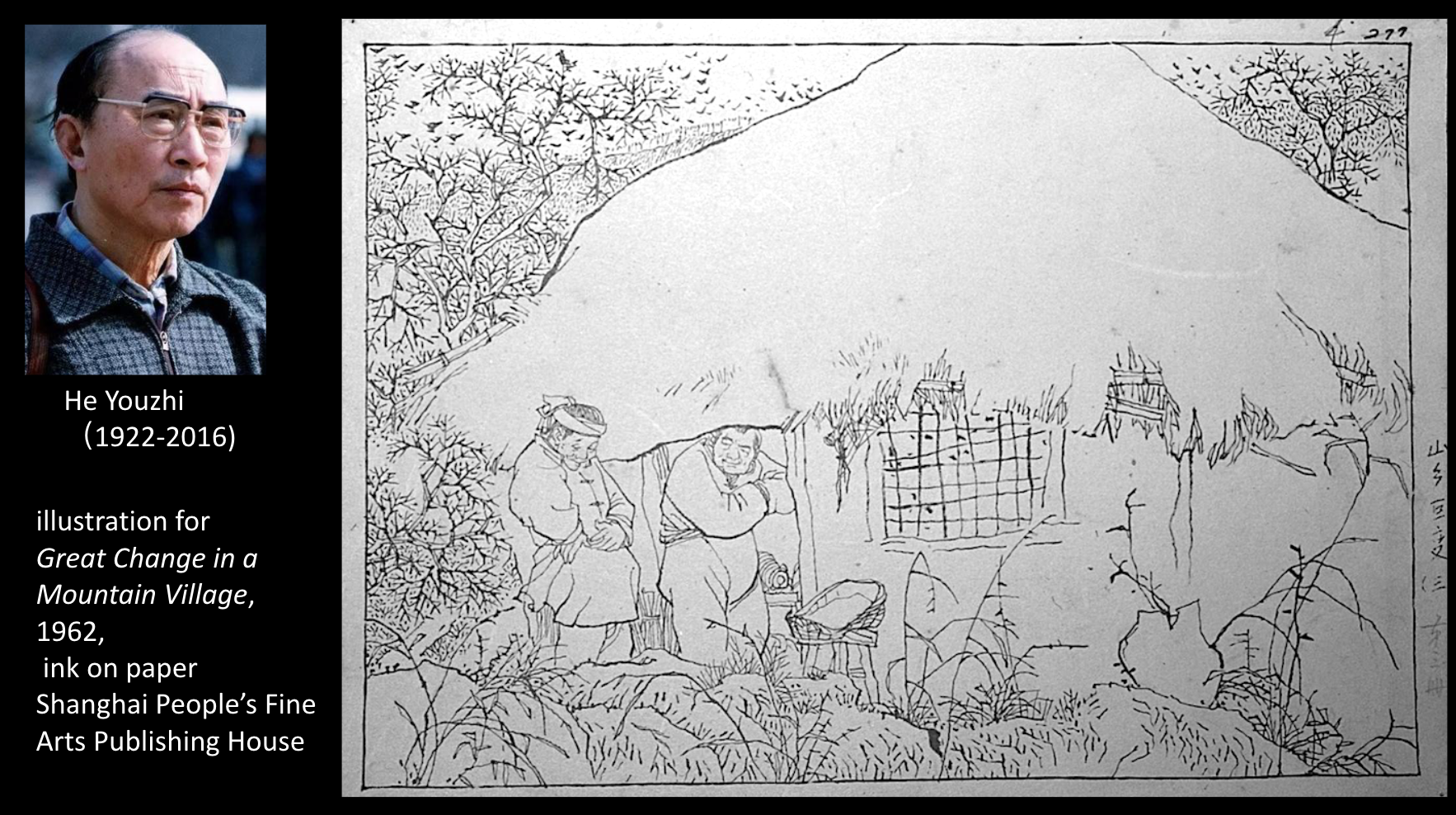
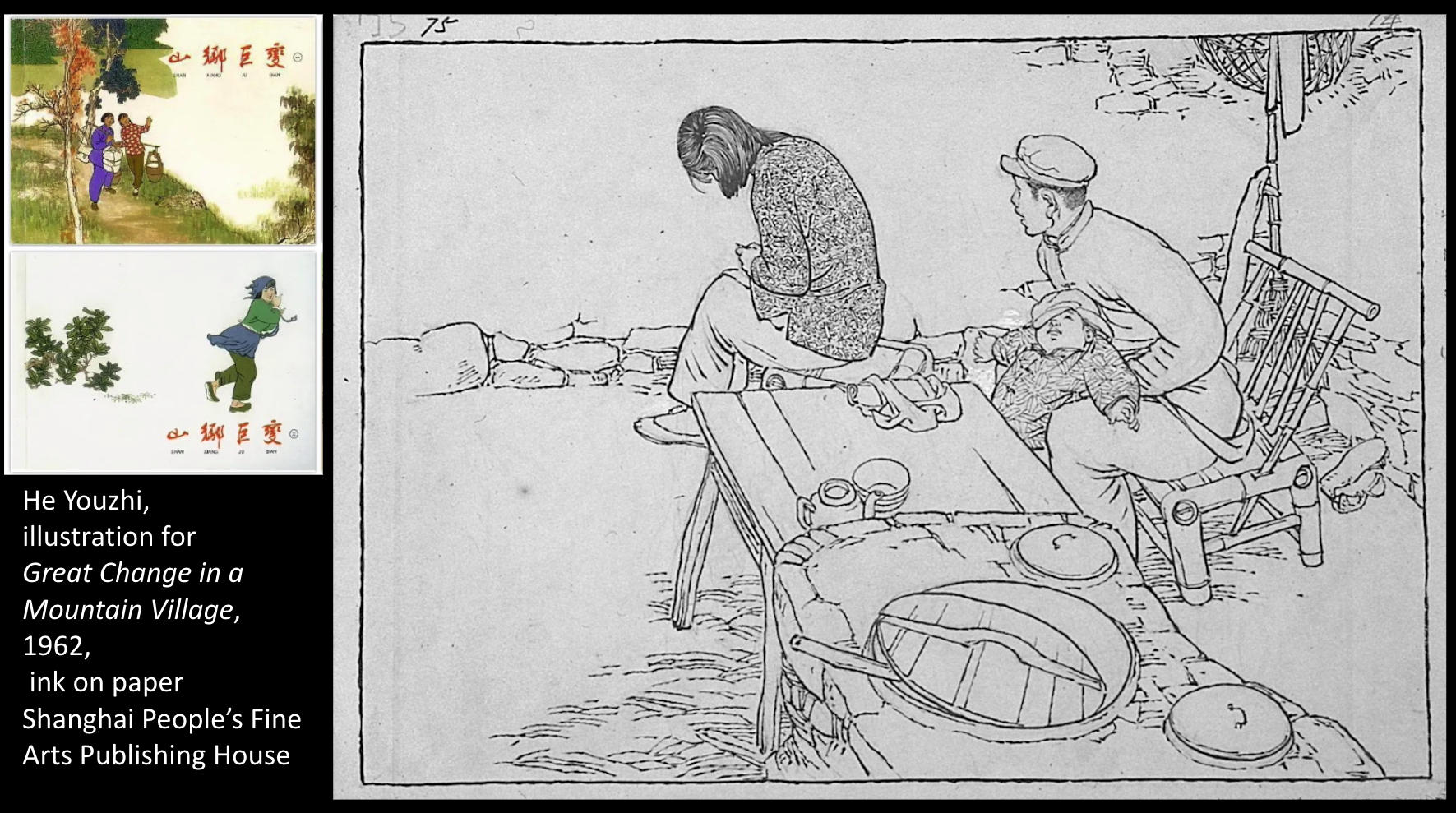
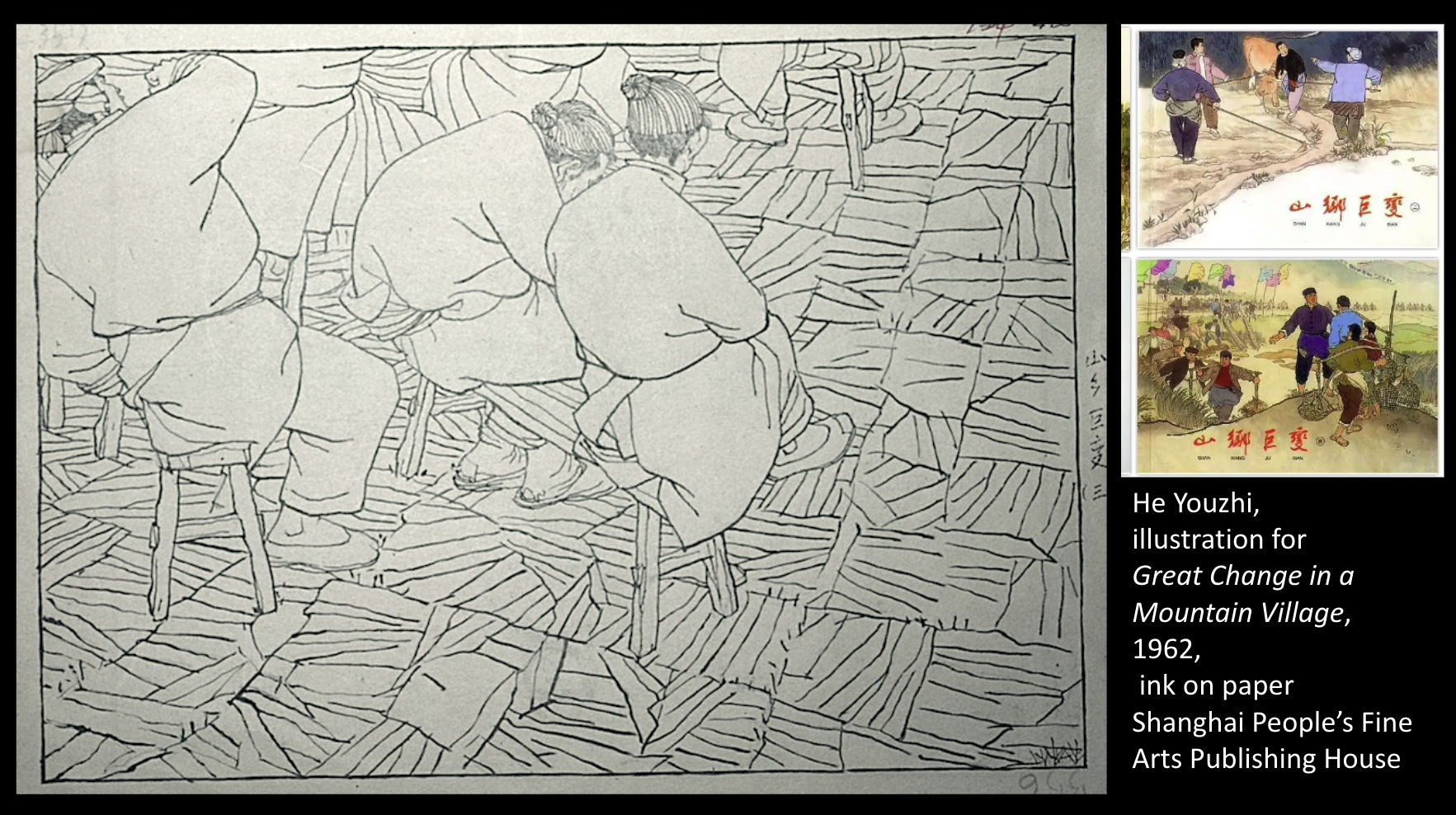
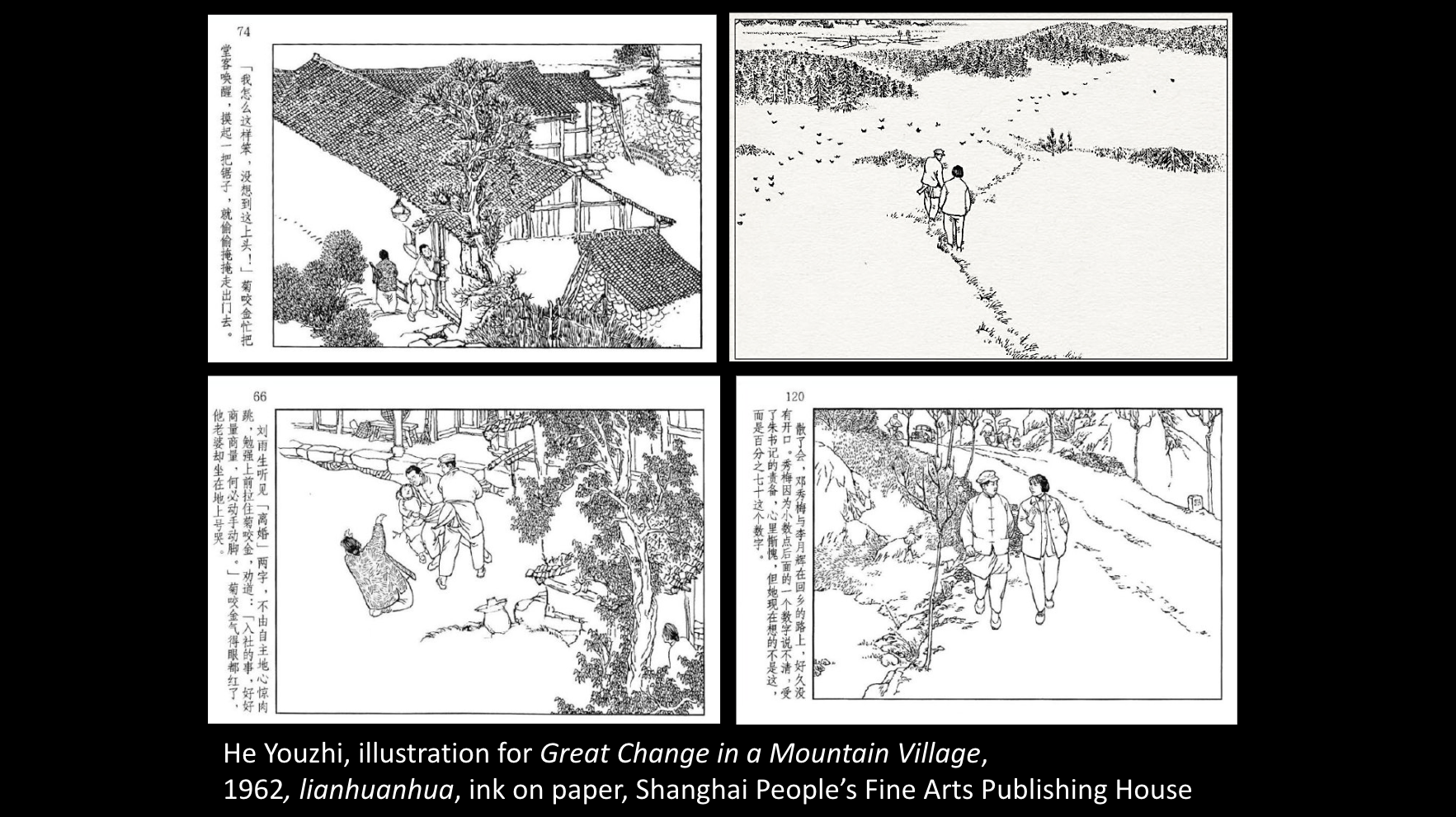
In a significant conceptual shift that emerged from the Communist Party’s increasing emphasis on China’s native heritage, in about 1954 publishing houses began to look more closely at premodern forms of illustration as potential source material for modern techniques and styles. As a result, in the lianhuanhua workshops of Shanghai, the outline manner common to comic books and funny papers around the globe was reconsidered in light of the conventions of premodern Chinese books. The new styles that developed in the late 1950s and early 1960s utilized Western perspective and anatomy to create vibrant and lively narratives, but adopted principles of composition and brushwork from the best of seventeenth-century woodblock-printed books. The result was an extraordinary technical finesse. He Youzhi 賀友直, who joined the New Art Press of Shanghai in 1952, was one of the most brilliant illustrators to emerge in this period. He emulated the work of revolutionary elders, including his studio supervisors, Gu Bingxin 顧炳鑫and Zhao Hongben 趙宏本, both of whom had been interested in the woodcut illustrations of the seventeenth-century painter and printmaker Chen Hongshou 陳洪綬, as well as those of the nineteenth-century painter Ren Xiong 任熊. In the Marxist historiography of the time, both were considered to serve the needs of working-class people through their contributions to popular literature. He Youzhi’s greatest success was The Great Change in a Mountain Village 山鄉巨變 (Shanxiang jubian), based on a 1955 book of the same title by Zhou Libo 周立波. It describes, in rather propagandistic terms, the successful communization of a rural village. Its five hundred individual pages are strikingly varied in point of view, a brilliant visual strategy that varies the appearance of otherwise repetitive narratives and brings poignancy to the psychological dilemmas of the characters.
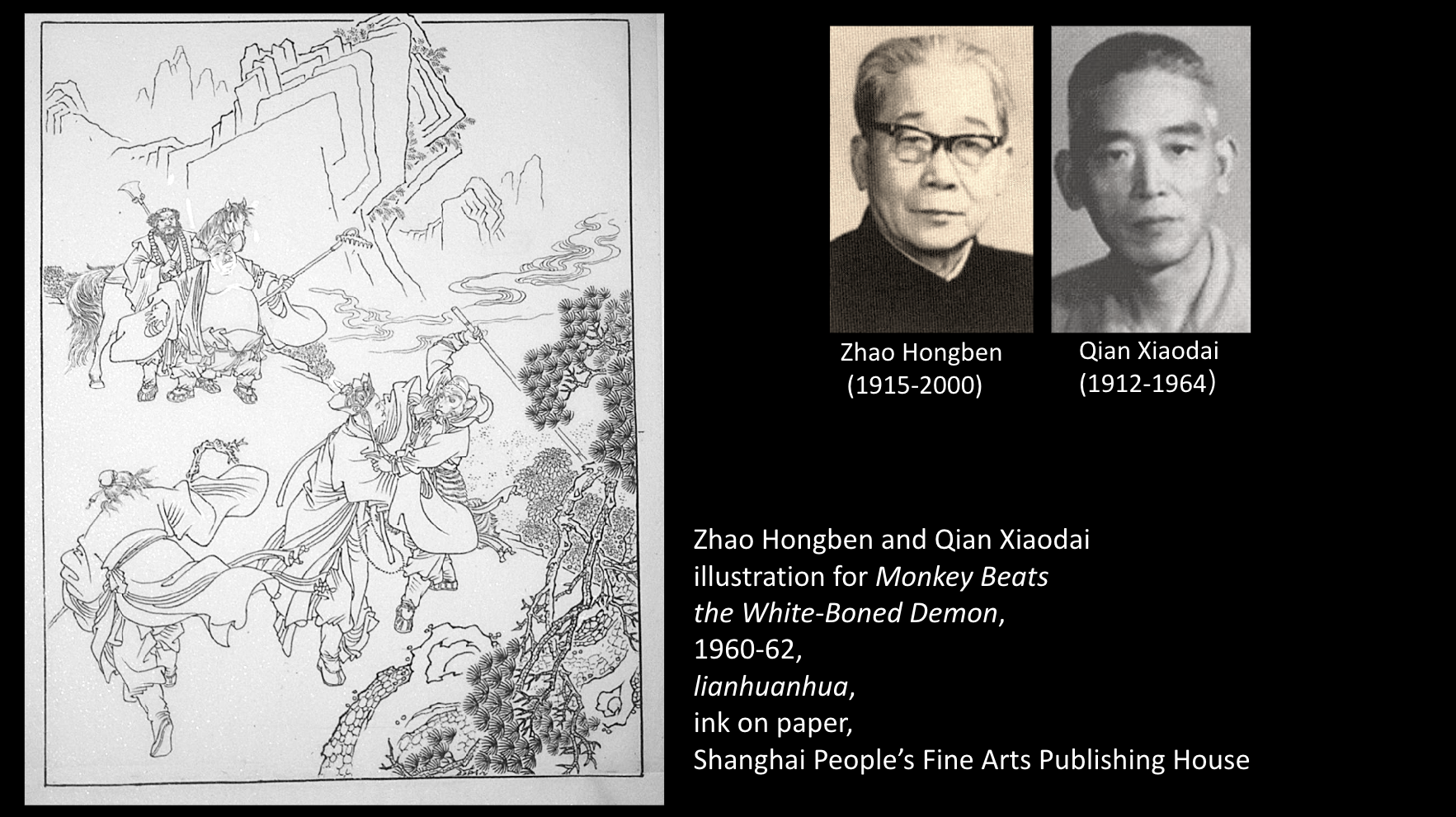
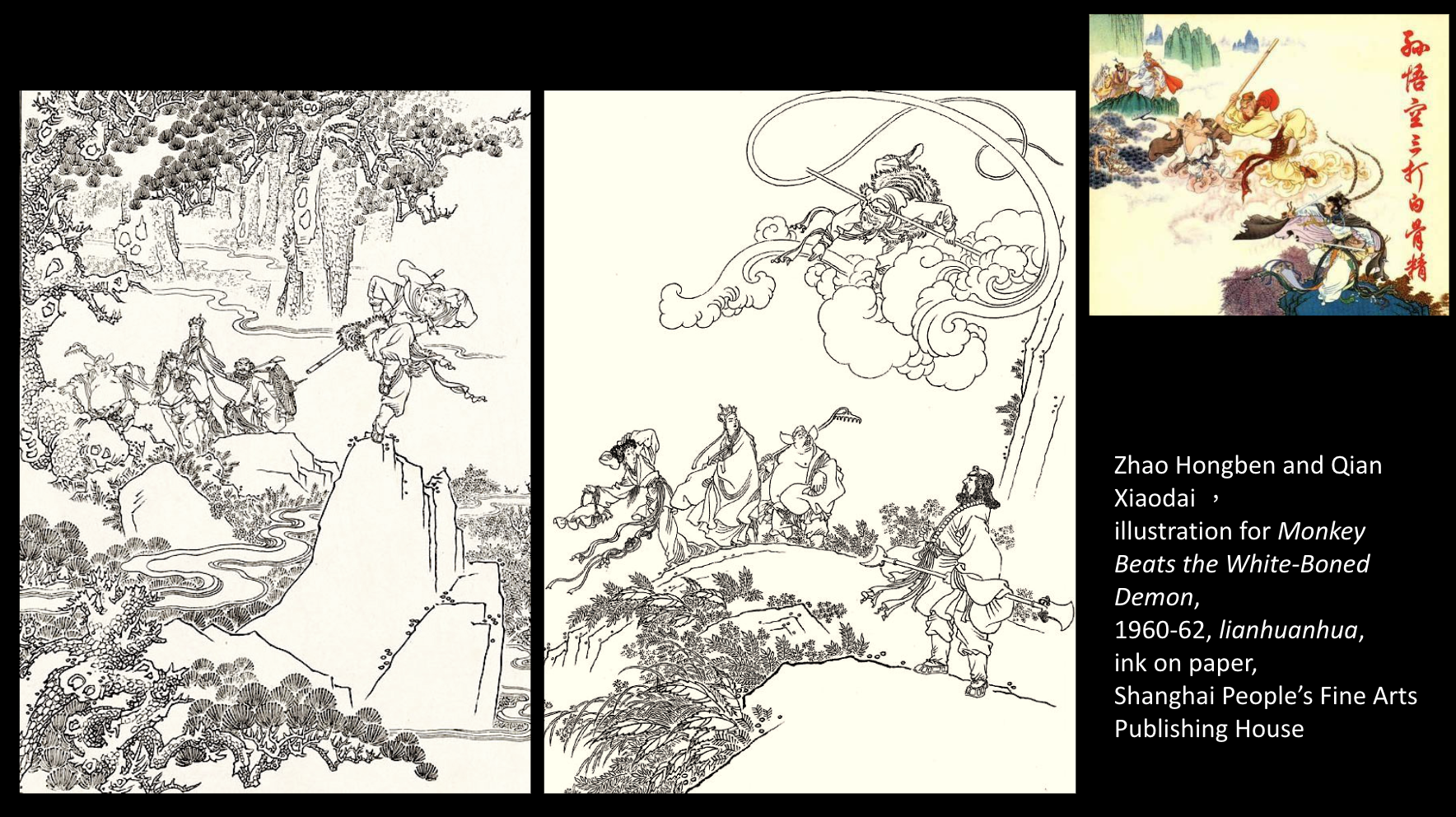
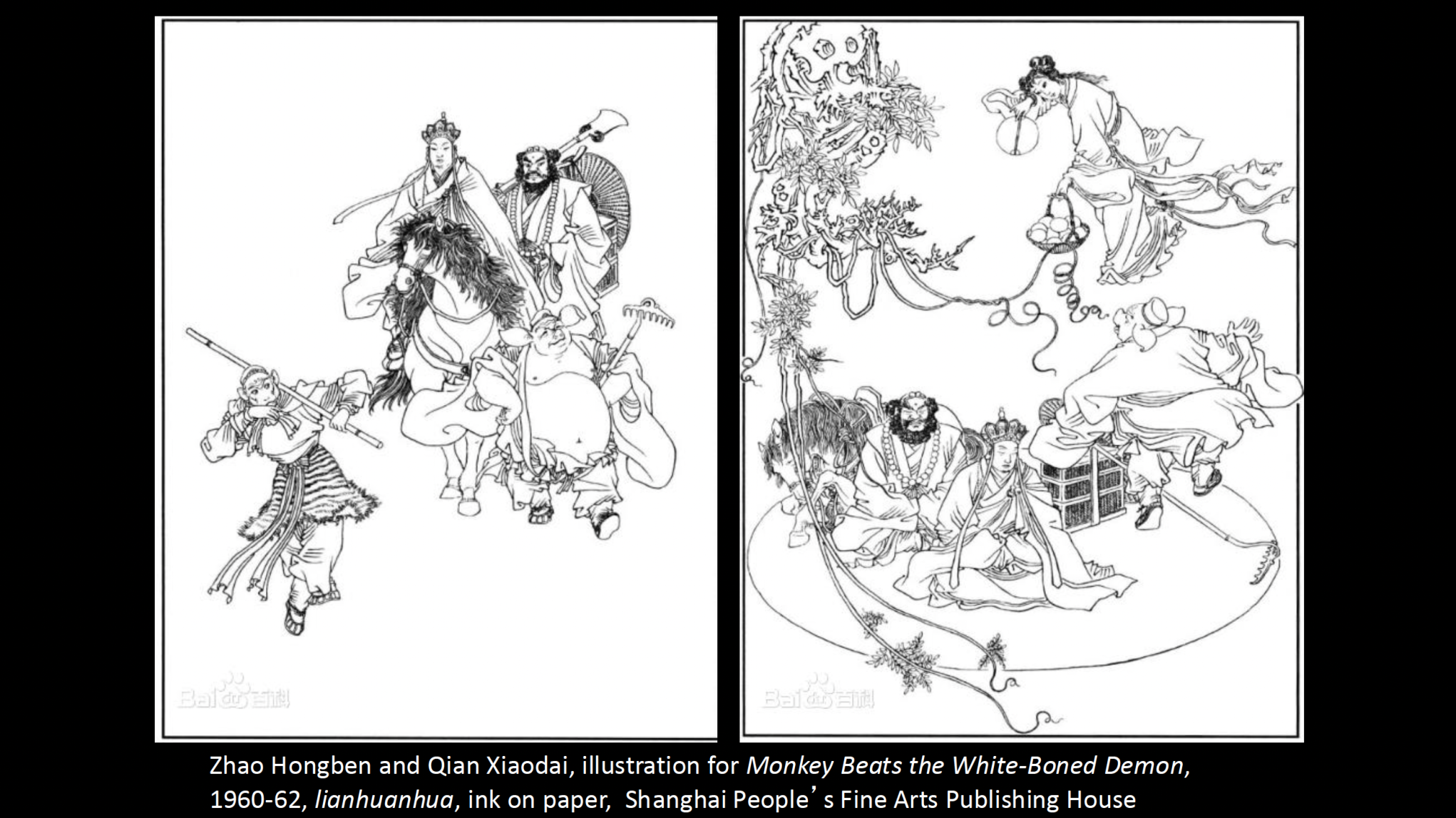
The shift in party guidelines for popular art encouraged the revival of “ancient costume” stories, which, just a few years earlier, might have been considered “feudal” for their lack of overtly didactic content. Filled with miraculous tales and martial arts, these narratives enjoyed enormous popular appeal. One such example published at the height of the cultural liberalization of 1962 was Monkey King Beats the White-boned Demon 孫悟空三打白骨精 (Sunwukong sanda baigujing) by Zhao Hongben 趙宏本 and Qian Xiaodai 錢笑呆. The story, taken from the Ming-dynasty novel Journey to the West 西遊記 (xiyouji), had been performed nationwide as a Shaoxing-style local opera the year before. Its strongly traditional pictorial style was well suited to the intensifying cultural nationalism of the late 1950s and early 1960s. Whereas He Youzhi had infused traditional elements into his essentially modern style, Zhao and Qian went the opposite route, bringing the “ancient costumes” 古裝 (guzhuang) genre up to date.
The Communist party placed extraordinary importance on the development of lianhuanhua as one of the most suitable ways of disseminating new social practices and party policies to the public. The twists and turns of cultural policy between 1949 and 1966 did not change this priority but did cause turmoil in the selection of styles and story lines. Nevertheless, the financial resources and time dedicated to training and supporting lianhuanhua artists, as well as the great concentration of talent in the studios, created an environment in which these gemlike works were far more successful as works of art than the government programs they promoted as policy.
Thank you.
JD: Thank you, Professor Shen, for that fascinating overview. We will have the opportunity for further discussion and questions in a moment, but first, let’s hear from our second speaker, Professor Zheng Shengtian.
Zheng Shengtian: Good evening, I’m so happy to be here. Jane, thank you for the introduction and for inviting me back to New York. Tonight, I would like to share with you my own experience with lianhuanhua. That’s why I’m calling my talk “Lianhuanhua and Me”!
Lianhuanhua are often known as “little peoples’ books” 小人书, or children’s books, but for generations of Chinese readers, they were much more than that. They were portable libraries, art schools, and windows onto the world.
I grew up reading lianhuanhua as a child in Nanjing in the 1940s. I walked every day from my home to primary school. Along the road, there were small stalls renting lianhuanhua for just a few coins.
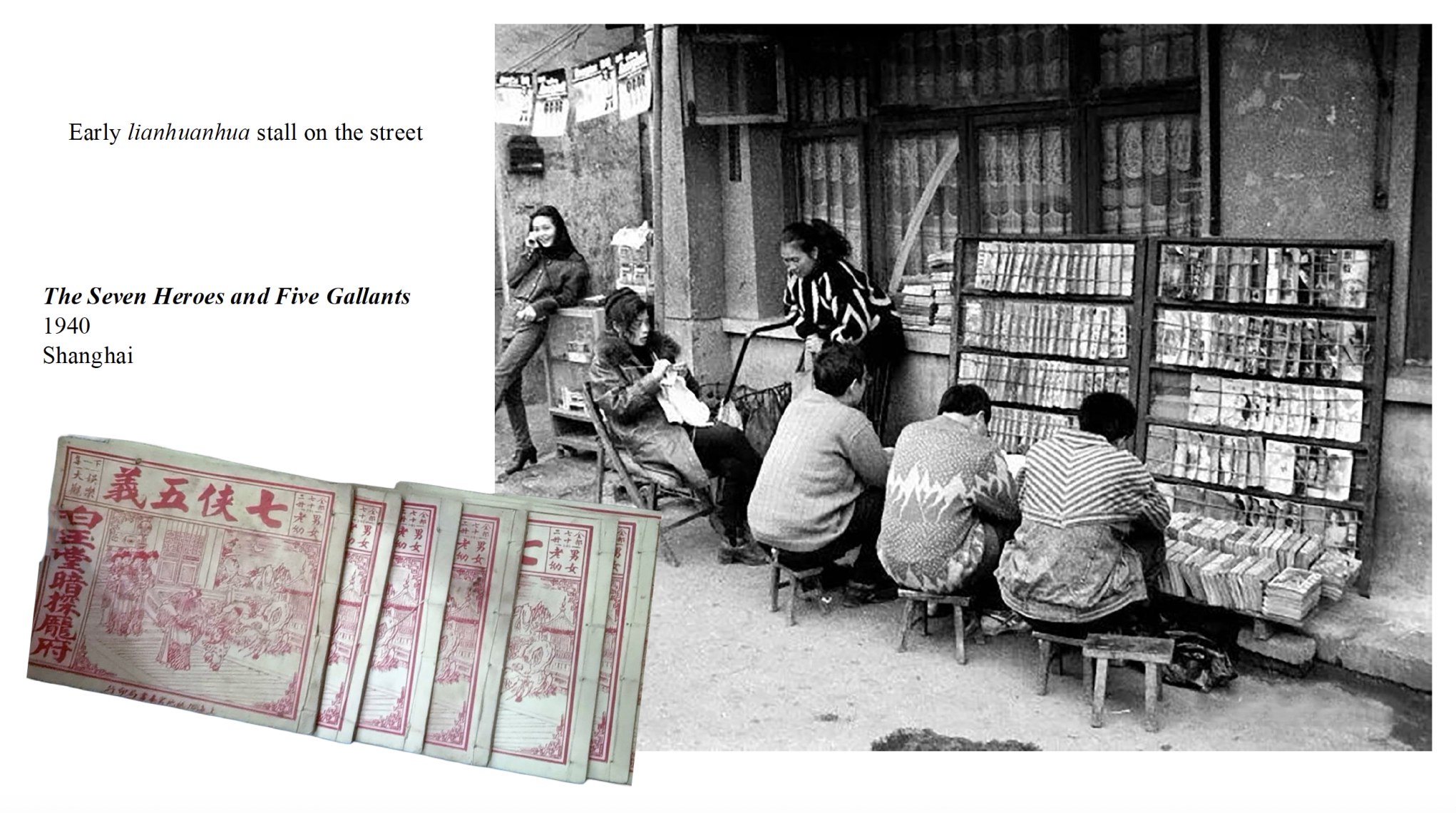
I remember that, on the small street between my school and my home, there were two stalls, and my little brother and I would visit one or the other almost every afternoon, despite my brother’s objections. He was a very obedient child, and he always listened to what my mother said, that we had to go straight home, be on time, and do our homework. Nevertheless, I always stopped at these stalls, rented several books, and sat reading for hours before finally returning home, usually to be scolded by my mother.
Those little books became my first education in literature, history, theater, and the visual arts. Through titles like All Men Are Brothers 水浒传 (Shuihuzhuan) and Seven Heroes and the Five Governments 七侠五义 (Qi xia wu yi), I entered a world that was larger than my own childhood.
In postwar China, there were not only traditional Chinese lianhuanhua, like Professor Shen just introduced, there was also an also important comics culture.
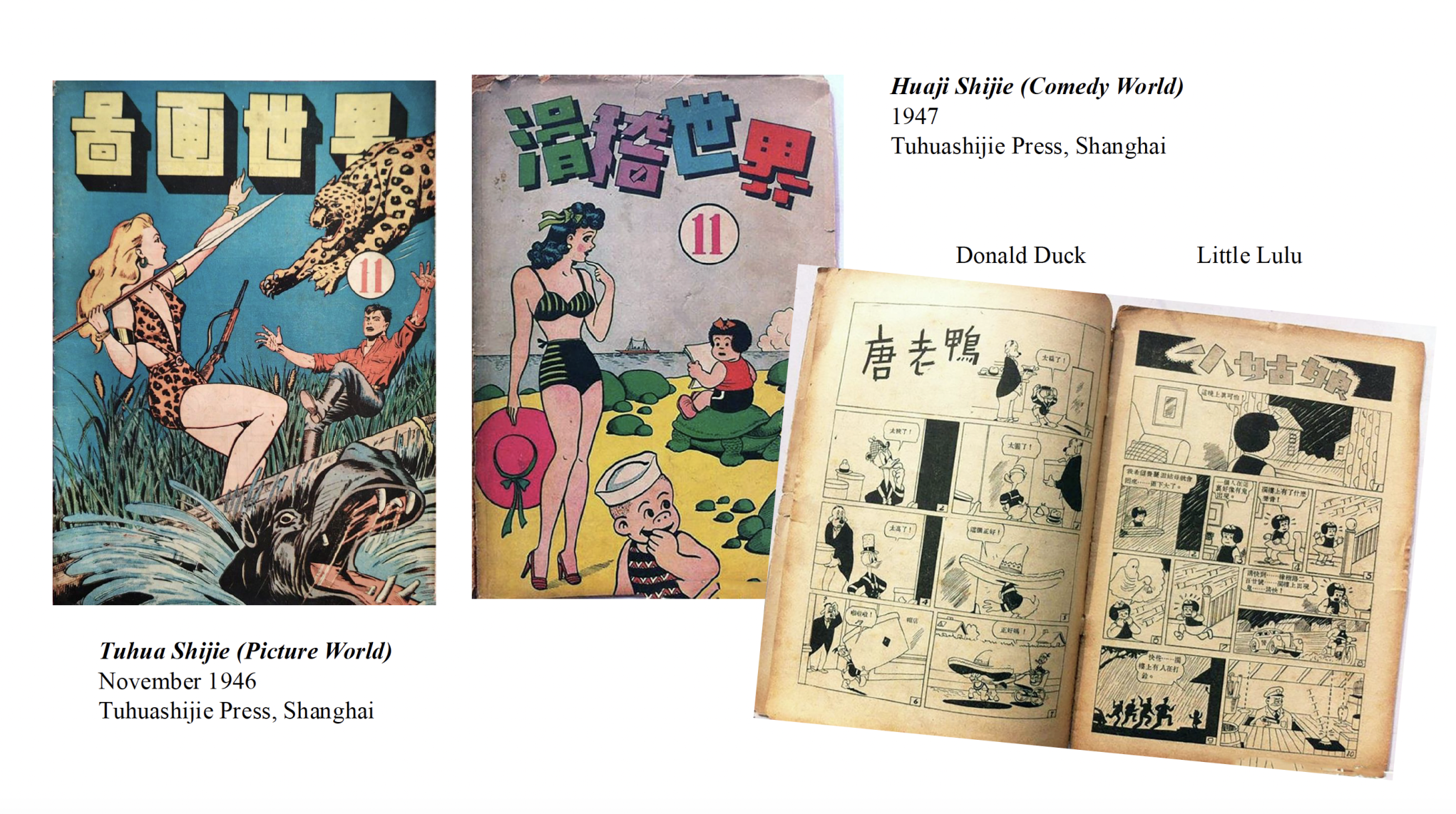
Magazines such as Comedy World 滑稽世界 (Huaji shijie) and Picture World 图画世界 (Tuhua shijie) introduced Disney characters, such as Mickey Mouse and Donald Duck, and other cartoon characters, like Popeye, to our world. Picture World mainly published stories of adventure and sci-fi, like those of Tarzan and Sherlock Holmes. These magazines introduced Western popular culture to Chinese readers long before globalization became a common word. But due to their relatively high price, they were far less popular than traditional Chinese lianhuanhua, which were cheaper.
My art education came from three sources when I was a kid. One, of course, was lianhuanhua. I read them every day. The second was these kinds of comic books, published mostly in Shanghai, Guangzhou, and some other big cities, but they were expensive and difficult to get. And the third kind of art education I got was from my first elementary school in Chongqing, during World War II, which was a Christian school. We had a teacher, Reverend Gordon Aldis 姚如云, who asked us to recite the Bible every Sunday morning. If you did a good job, he would give you a beautiful little card with a picture of a famous painting by a Renaissance or other European artists. These cards were printed very well, of good quality and in color. So, I would try to get as many cards as possible. I kept reciting the Bible, and even now I can still remember some lines. That was my first exposure to Western art history.
At the age of eleven, I entered Yucai School 育才学校, founded by the great educator Tao Xingzhi 陶行知, who had graduated from Teachers College of Columbia University in New York. One of our teachers, Ma Shanhe 马三和, was especially talented at drawing cartoons, and we students eagerly borrowed his sketchbooks.
Inspired by him, I drew my first cartoon. It was published in the New Youth Newspaper 新少年报 (Shaonian huabao) in Shanghai, and from it I received my first “paycheck.” I was eleven. I was so happy! I brought the money back to show my mother. We were a family of eight children. All my older siblings at that time were in high school or college, and my mother said, “You are the first one who brought back money. So, you can spend it.” I remember it was about five yuan. I went to a secondhand market and bought a pair of American military boots, which was such a luxury for a young boy. I made all my classmates jealous.
In 1953, I went to Hangzhou and entered the China Academy of Art. At that time, it was called the Eastern China branch of the Central Academy of Fine Arts 中央美术学院华东分院. There I started to draw lianhuanhua in my spare time. Beginning in 1949, and for quite a long time after, drawing lianhuanhua was the only way that artists could earn money. Even if you got a chance to participate in an exhibition and you submitted a painting, whether it was an ink-and-brush painting or a large-scale oil painting, nobody would pay you anything, and there were no collectors to buy your work. And even if the museum wanted to collect your work, you would only get paid a small amount of money—it was called a material fee. Your labor was not compensated. Compared to this, the fee for creating lianhuanhua was quite high. I remember when I was doing my first or second book, the price was about five to ten yuan per page. My first few books were about thirty or forty pages long, so I would make several hundred yuan, which was more than a professor’s monthly salary. That money could support me for an entire semester. For this reason, a lot of students tried to learn how to paint and draw lianhuanhua, but not everybody could meet the requirements, because you needed to be speedy: You needed to do it fast, and you needed to do it well.
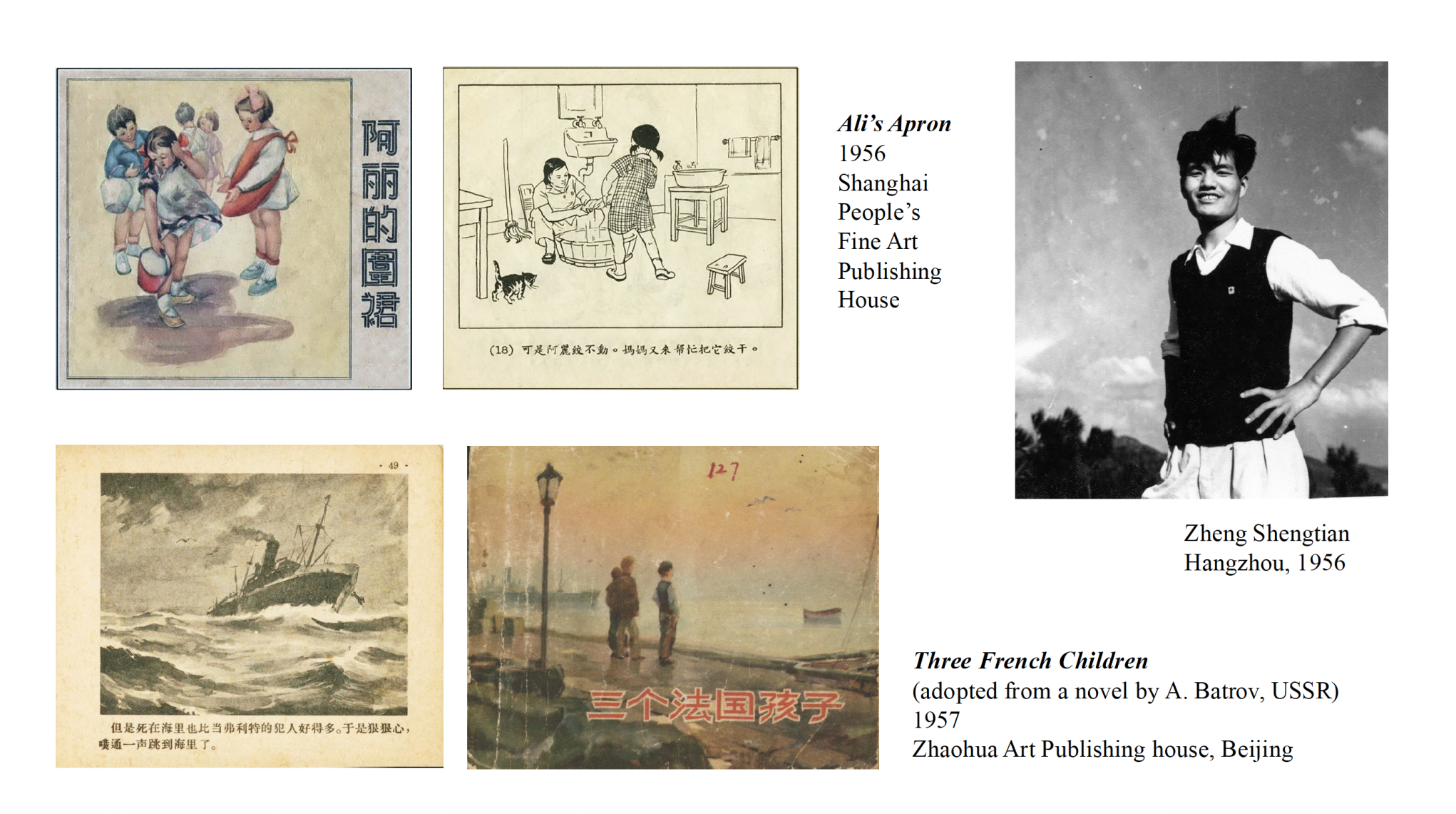
My first lianhuanhua was called Ali’s Apron 阿丽的围裙 (Ali de weiqun), and it was a collaboration with my classmate Zhou Hesheng 周荷生. I am very grateful to him, as he was the one who introduced me to the editor of Shanghai People’s Fine Arts Publishing House, a connection that would prove very important. The story was adapted from a Soviet children’s book about a little girl who learned to do housework. It was very short, maybe twenty pages. My second book was more complicated. It was called Three French Children 三个法国孩子 (San ge faguo haizi). Publishers usually supplied the scripts themselves, which had already passed political review. It is likely that, because I was studying Western oil painting, I was given more chances to paint foreign themes. This lianhuanhua, also adopted from Soviet literature, tells a story about three French boys who board a cargo ship and become enslaved by the ship’s owner. Eventually, one boy dies of sickness, and the other two jump from the ship and are saved by Soviet sailors.
I graduated from the academy in 1958. The turmoil of the Great Leap Forward had not yet subsided. It was during this time that my school established the Zhejiang People’s Fine Art Publishing House, where I was assigned to work as an editor. There, I became editor-in-chief of a new bimonthly magazine called Leap Forward Pictorial (Yuejin huabao). This was the first time that I was in charge of a publication. And since then, I feel like my life and work have been bonded to publishing.
The process of commissioning, editing, and printing articles went on and on without any breaks. In practice, we had only two editors, myself and a young woman named Yin Yu-e 应玉娥, who had graduated from an affiliated middle school of the academy. I brought several copies that I saved, so you may look at them after this talk.
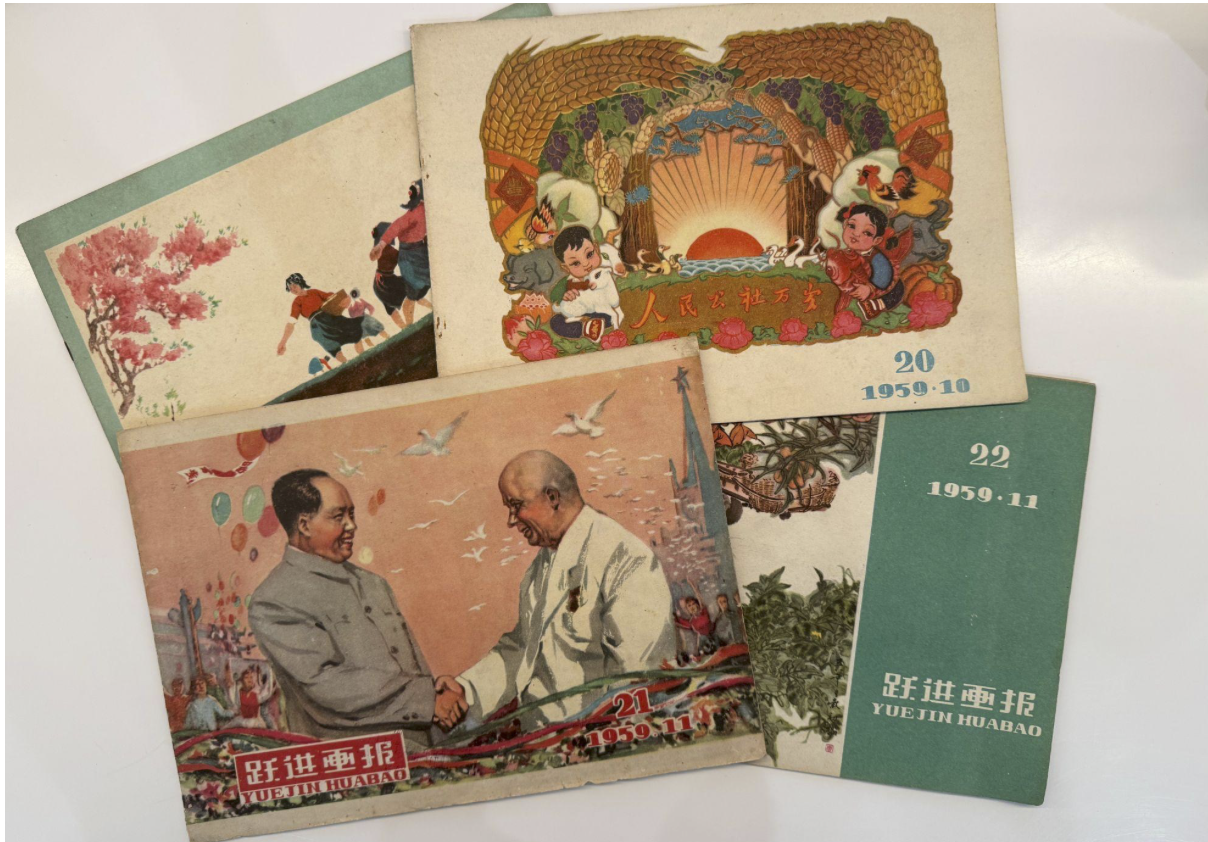
Fortunately, we were both young and energetic, running back and forth between the editorial office and the printing factory every day. Back then, there were no computers, no photocopiers or fax machines—only scissors, glue, ink, and endless manual labor. And we had to create complete stories within a matter of days, to fill the empty pages of our publication before printing deadlines.
I remember one very interesting story. It was right before October 1, which is Chinese National Day. We wanted to publish a special issue to celebrate the occasion, but we realized that we did not have a good image for the cover to suit this theme. So, we decided to screw up our courage and ask [the famous artist and president of the academy) Pan Tianshou 潘天寿. My colleague and I went to his home and said, “Professor Pan, we need a painting for the cover of this magazine to celebrate Chinese National Day. Can you do a painting for us in a couple of days?” He was very nice and replied, “Sure. Come back tomorrow. I will give it to you.” The next day, we went to his home. He gave us a really nice flower painting. Unfortunately, I don’t know where that original is now, but that cover of the issue was widely praised.
I want to emphasize that working for this kind of publication was important because it reached a lot of people, and also because it taught me that lianhuanhua was never just about illustration. It was about collaboration, storytelling, design, education, and mass communication.
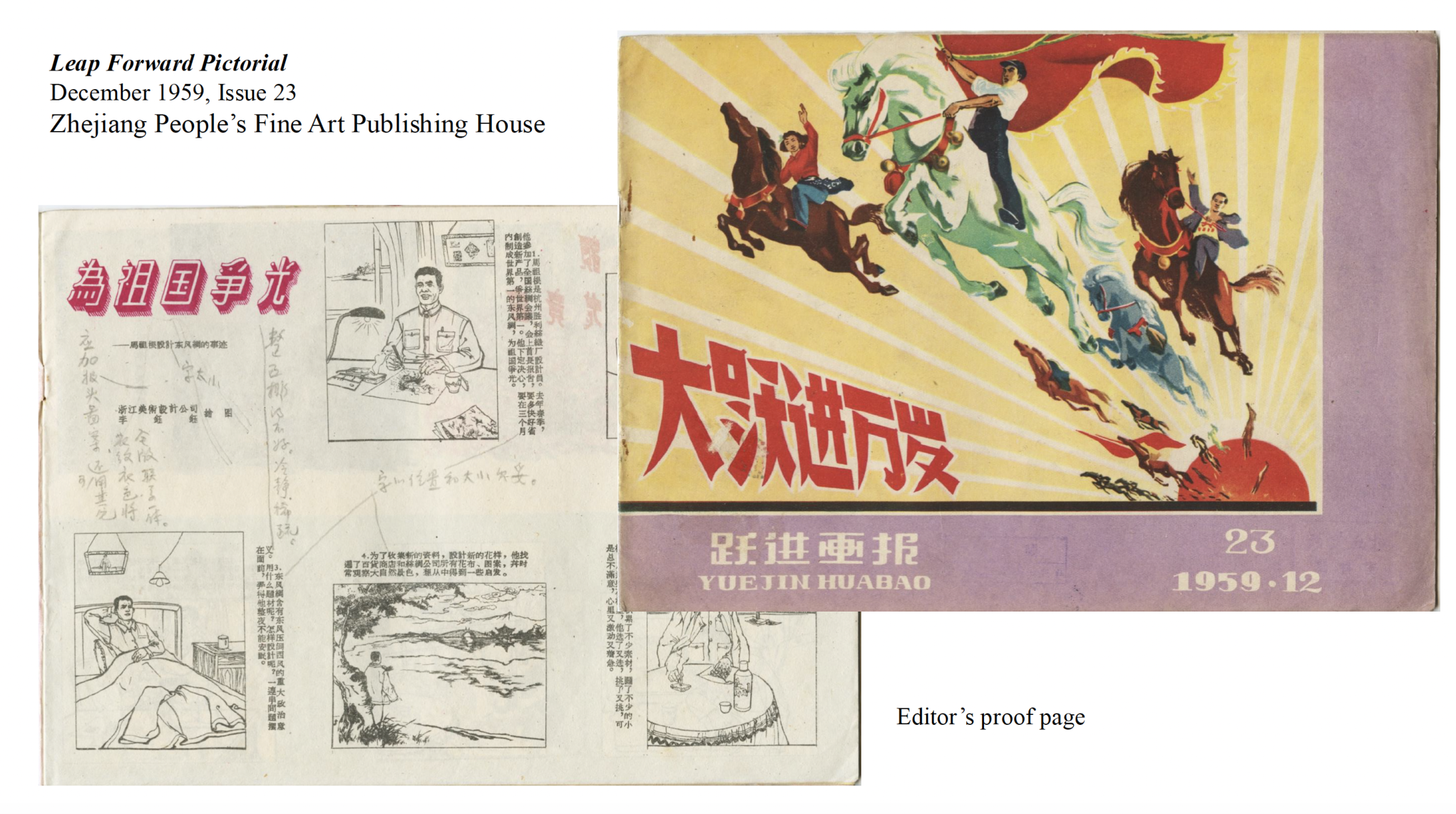
In 1959, China entered a difficult period. Many projects were abruptly halted, including our Leap Forward Pictorial. It was only published for about two years and it eventually stopped. The main reason, we were told, was a lack of paper supply. After its closure, I was assigned to another job related to lianhuanhua. I was transferred to the printmaking department to set up a studio called the Lianhuanhua and Propaganda Poster Studio 连环画宣传画工作室. By this time, most Chinese art academies had adopted the Western and Soviet art education system, focusing on cultivating high-end, elite fine art and easel paintings. So, this studio may have been the first professional studio focused on popular art forms in China.
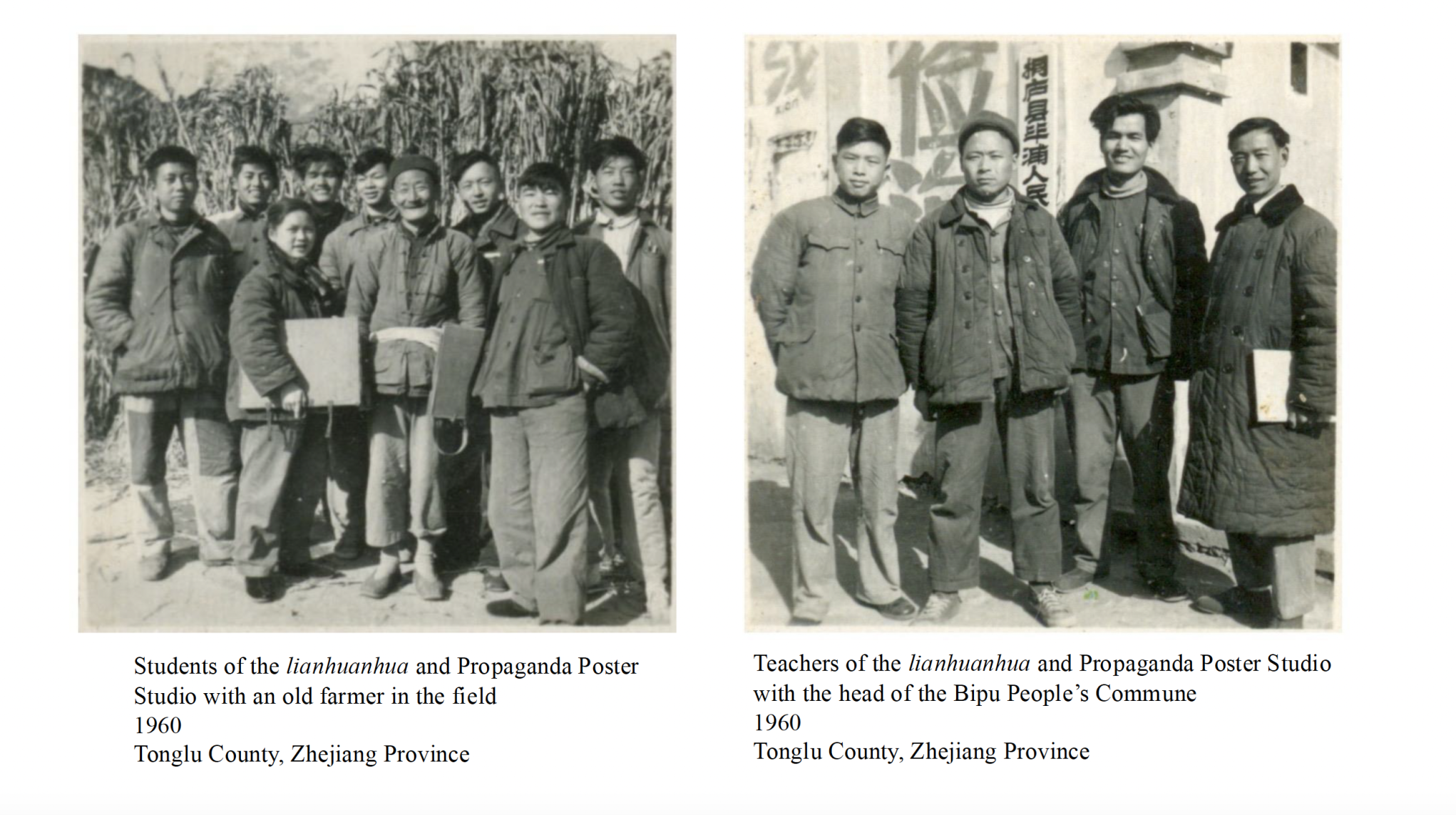
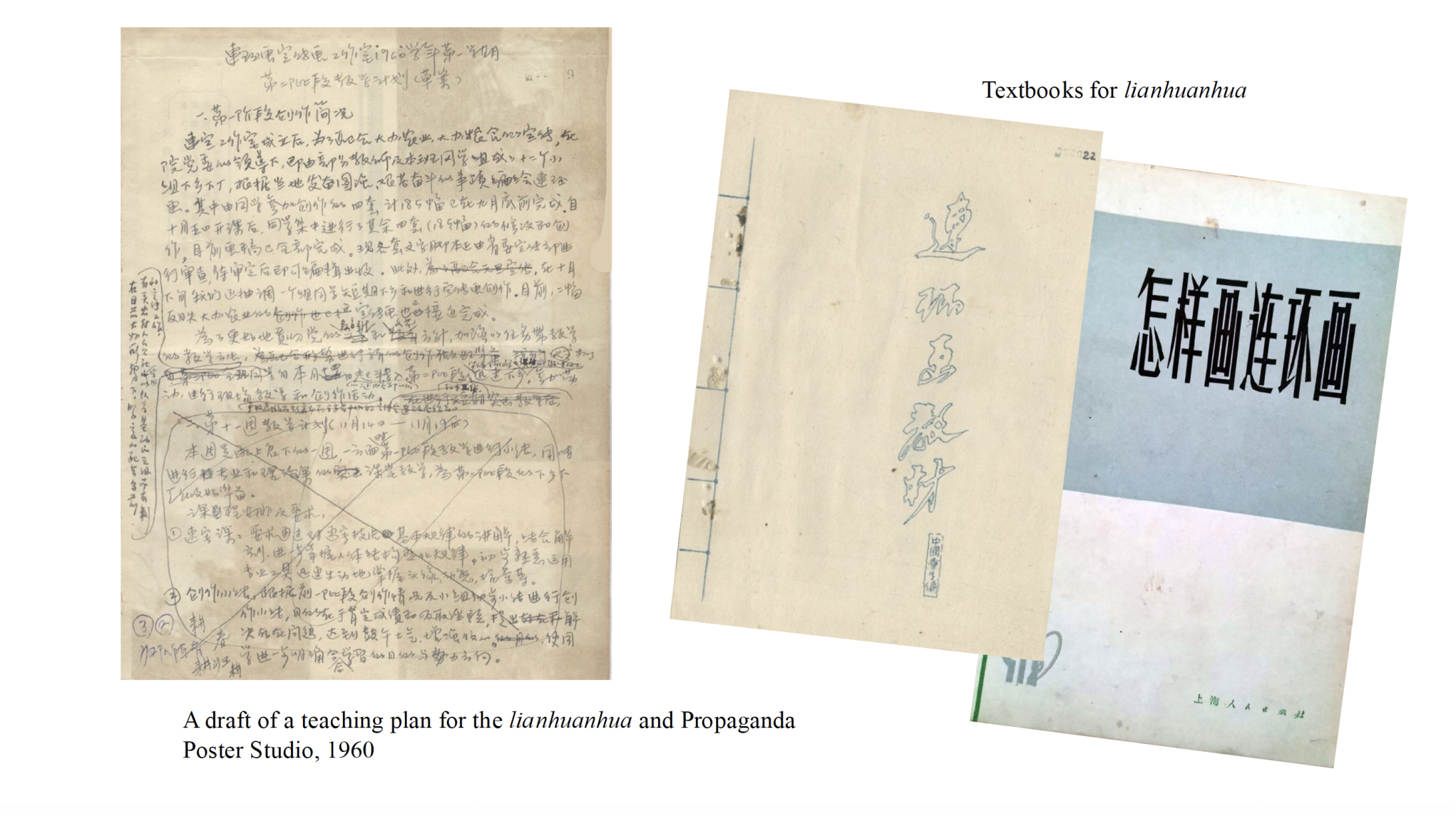
There three teachers total in the studio: myself, Lu Junti 陆俊倜, and Lu Fang 陆放. My colleagues had both studied in the printmaking department of the academy. Our twelve students—or disciples, to use Professor Shen’s term—were mainly graduates of the middle school affiliated with the academy. Everyone was full of enthusiasm for this new major. All instruction started from scratch. We developed the teaching plan, wrote the textbooks, and took students to factories and rural areas to collect materials and to create lianhuanhua onsite.
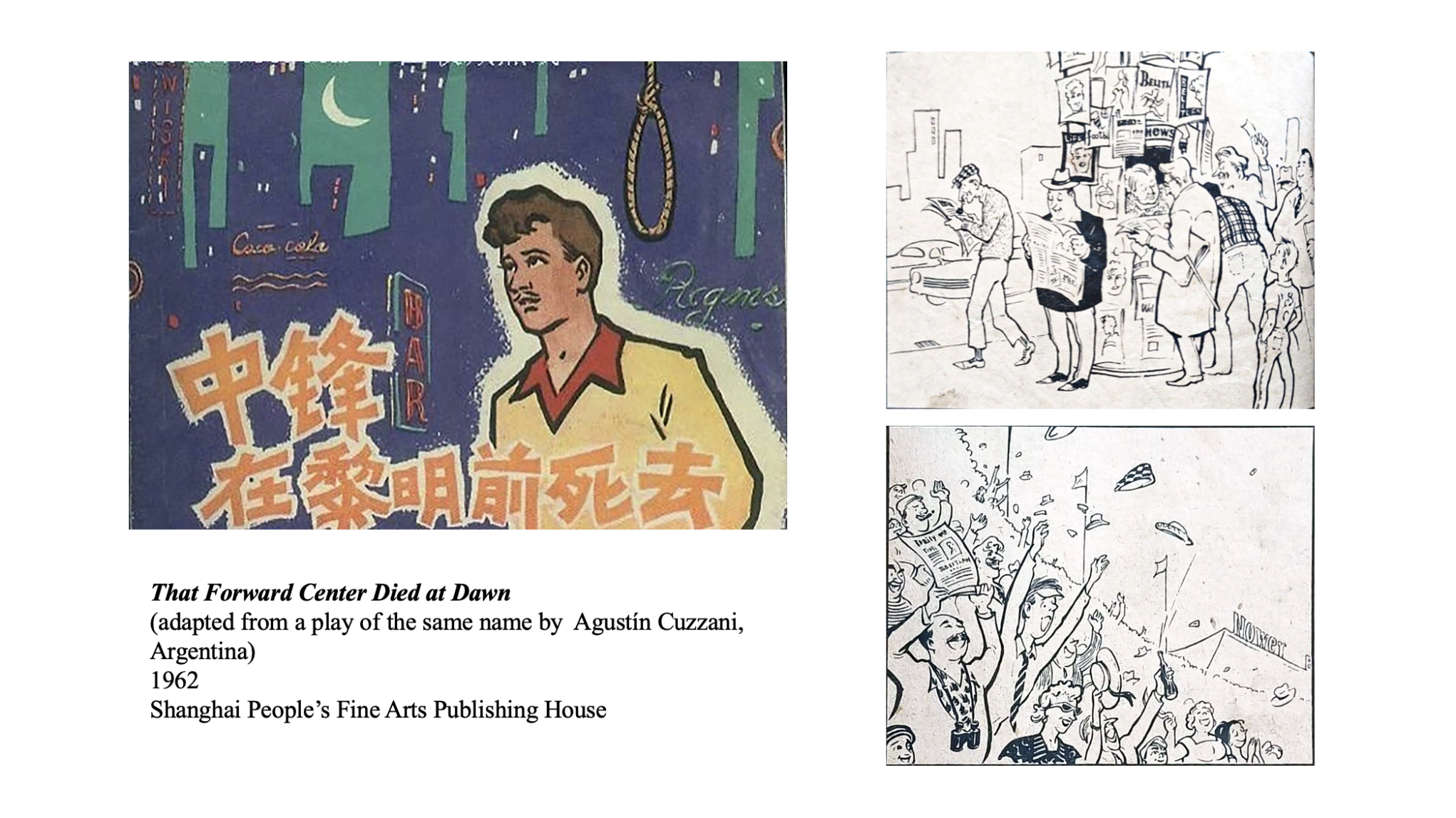
Unfortunately, this studio didn’t last long, either. It was disbanded after just one year, only two semesters, due to budget cuts. I was reassigned back to the oil painting department as a teaching assistant, but I still continued to create lianhuanhua. In 1962, I published one called That Forward Center Died at Dawn 中锋在黎明前死去 (Zhongfeng zai liming qian siqu) which was adapted from a play by the Argentine playwright Agustín Cuzzani. The film adaptation of this original work was nominated for the Palme d’Or at the 1961 Cannes Film Festival, and a dubbed version was released in China. The story deeply affected me. After completing this book, I even directed a stage production of the play.
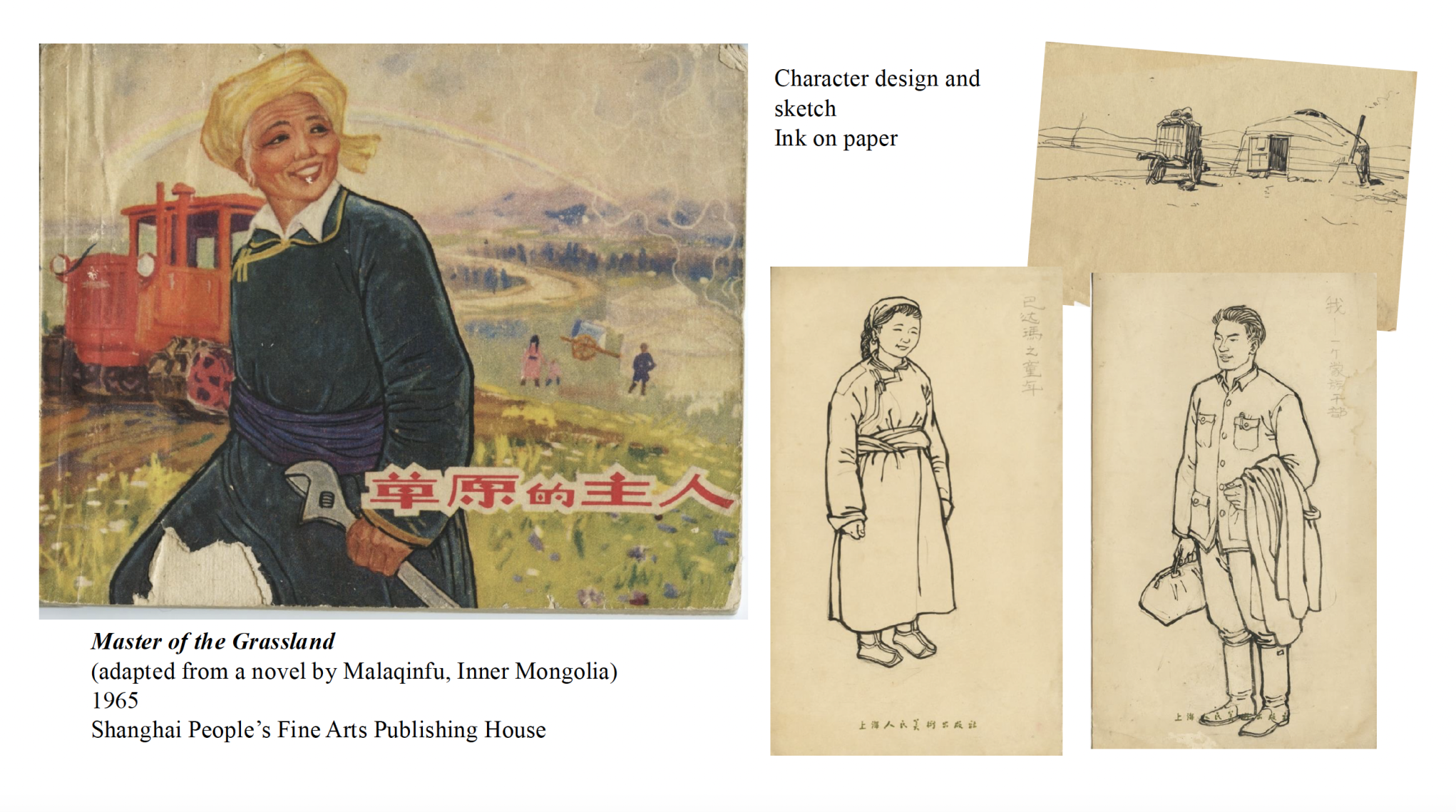
Around 1962, I traveled repeatedly to Inner Mongolia. I was strongly influenced then by Mexican muralists, such as Diego Rivera and Raúl Anguiano. Their monumental and direct visual language inspired me to search for a new artistic approach through the landscape and people of the grasslands. At that time, I created an oil painting called Home on the Prairie 家在草原 (Jia zai caoyuan), which was selected for the 1964 China National Art Exhibition.
I also made a lianhuanhua called Master of the Grasslands 草原的主人 (Caoyuan de zhuren), adapted from the novel by the famous Inner Mongolian writer Malaqinfu 玛拉沁夫. I combined extensive field sketches with traditional Chinese fine line drawing techniques. This was the first time I used Chinese ink and brush, which I learned by copying old masters.
Another Inner Mongolian project was called Little Sisters of the Prairie 草原小姐妹 (Caoyuan xiao jiemei), based on the true story of two girls protecting a flock of sheep during a snowstorm. It was also written by Malaqinfu. Most of the pencil drawings were completed by the time the Cultural Revolution erupted in 1966, but publications stopped overnight, so it was never finished.
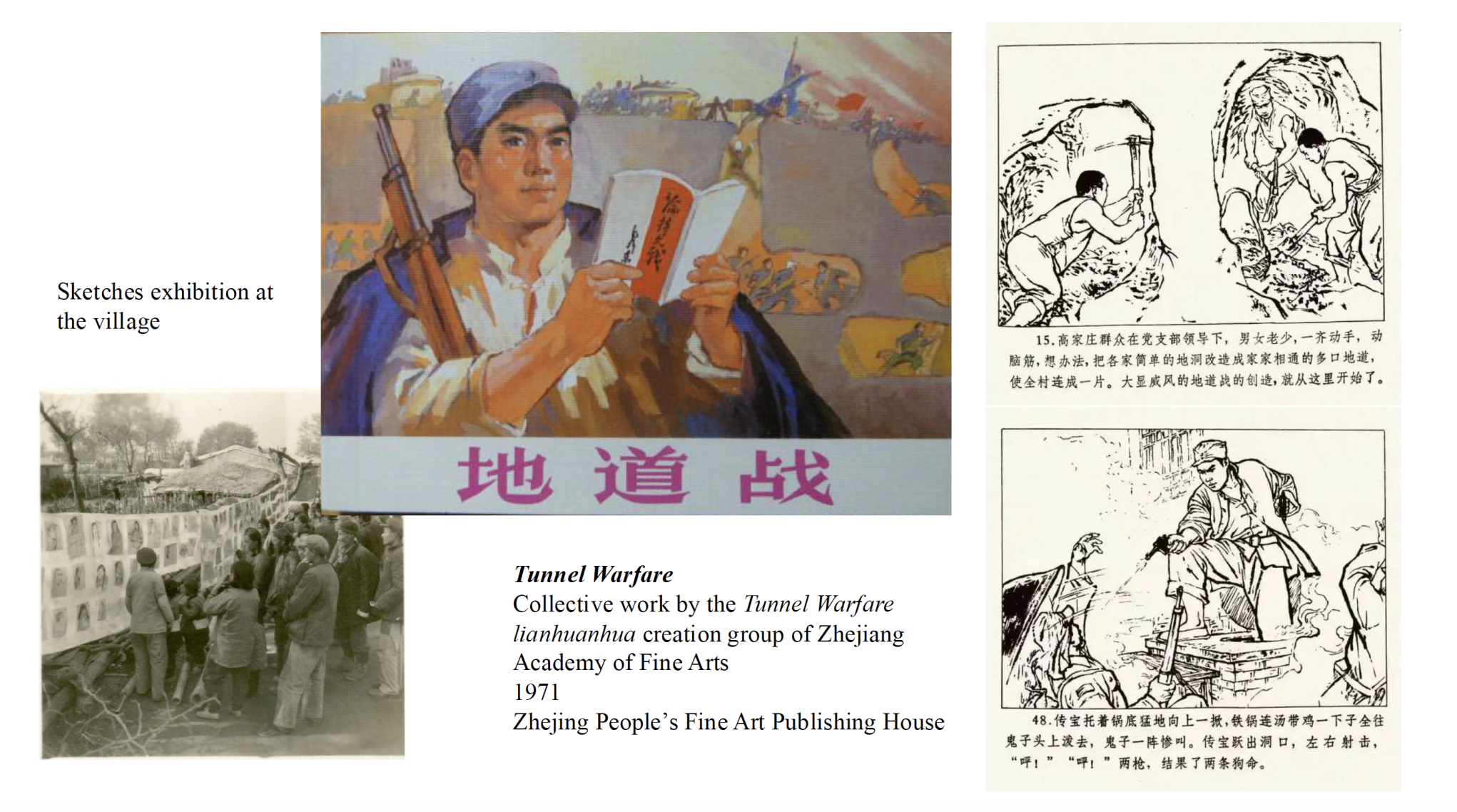
During the late 1960s and early 1970s, the height of the Cultural Revolution, some artistic activities gradually resumed. That’s when I joined a collective lianhuanhua project to adapt a famous anti-Japanese war story, Tunnel Warfare 地道战 (Didao zhan), along with my colleagues Zhang Pincao 张品操, Xu Junxuan 徐君萱, Chen Yujiang 陈聿疆, and Gan Zhenglun 甘正伦. Tunnel Warfare was first a novel and then became a film, which was released to the public at the beginning of the Cultural Revolution. Since then, it has been viewed by more than three billion people, making it one of the most widely distributed black-and-white films ever. In the summer of 1970, we made a special trip to Jiaozhuangghu 焦庄户, a village in Shunyi 顺义County, near Beijing, to study the historical site and sketch directly from life.
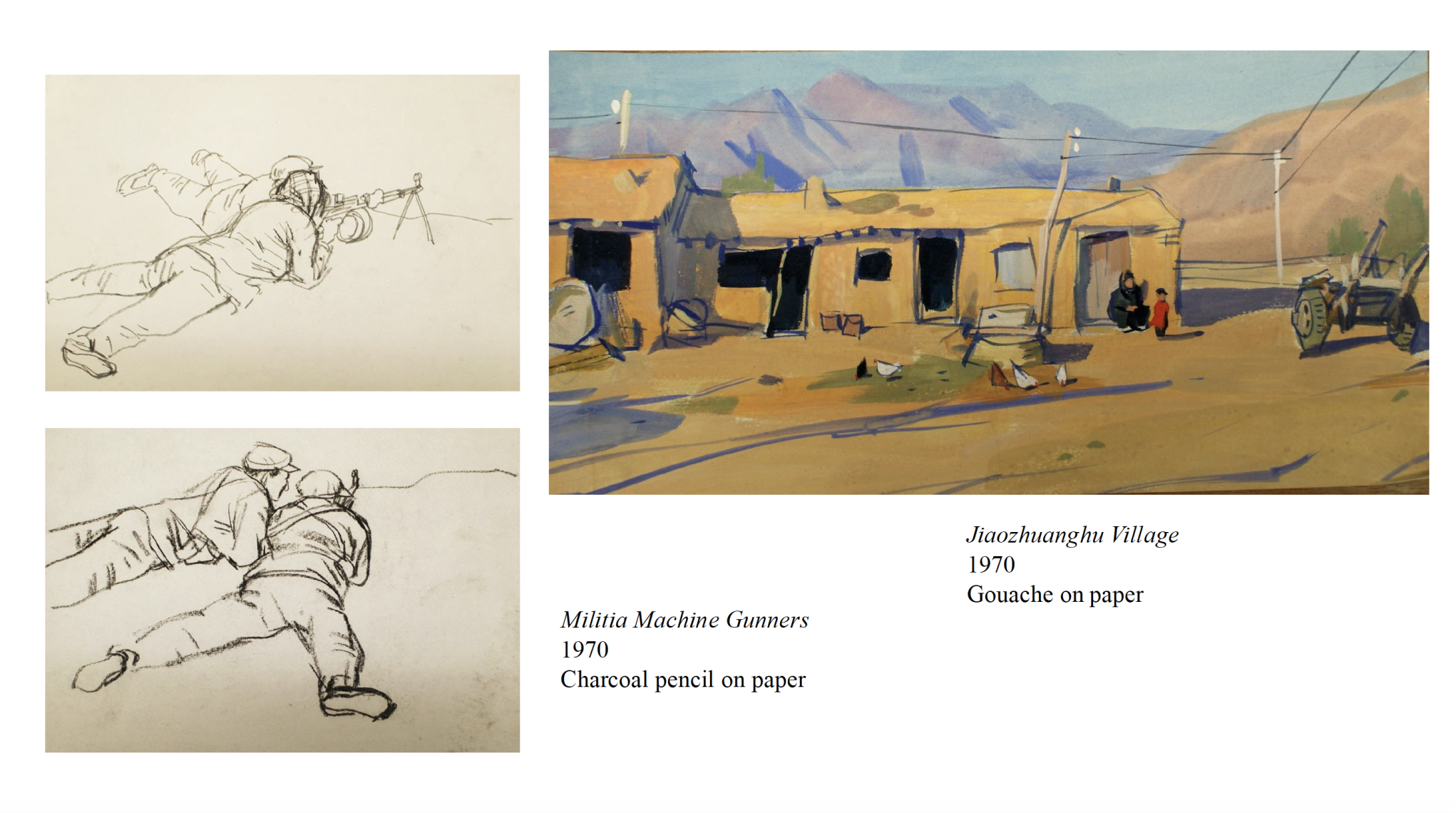
We stayed there for a couple of months and made a lot of sketches, watercolors of the landscape, the militia, and the local villages. And we used those sketches as the raw material for our creations. Like many lianhuanhua projects of the era, it was highly collaborative. Different artists handled research, composition, depiction of figures, and the final line drawings. This collective method reflected both political realities and traditional workshop practices. It is important to note that, at that time, no single artist’s name could be mentioned, not even on a single painting one created. You had to write the name of your school or the name of an organization, but not your own name, not the artist’s name.
Our final line drawing was done by Professor Zhang Pincao from the Chinese painting department. He has solid ink wash and fine line drawing skills. When Jane contacted me about her research on Tunnel Warfare, I chatted with Professor Zhang online and asked him to recall his process. He wrote a bit about his experience, but unfortunately, he passed away last year, never finishing his recollections.
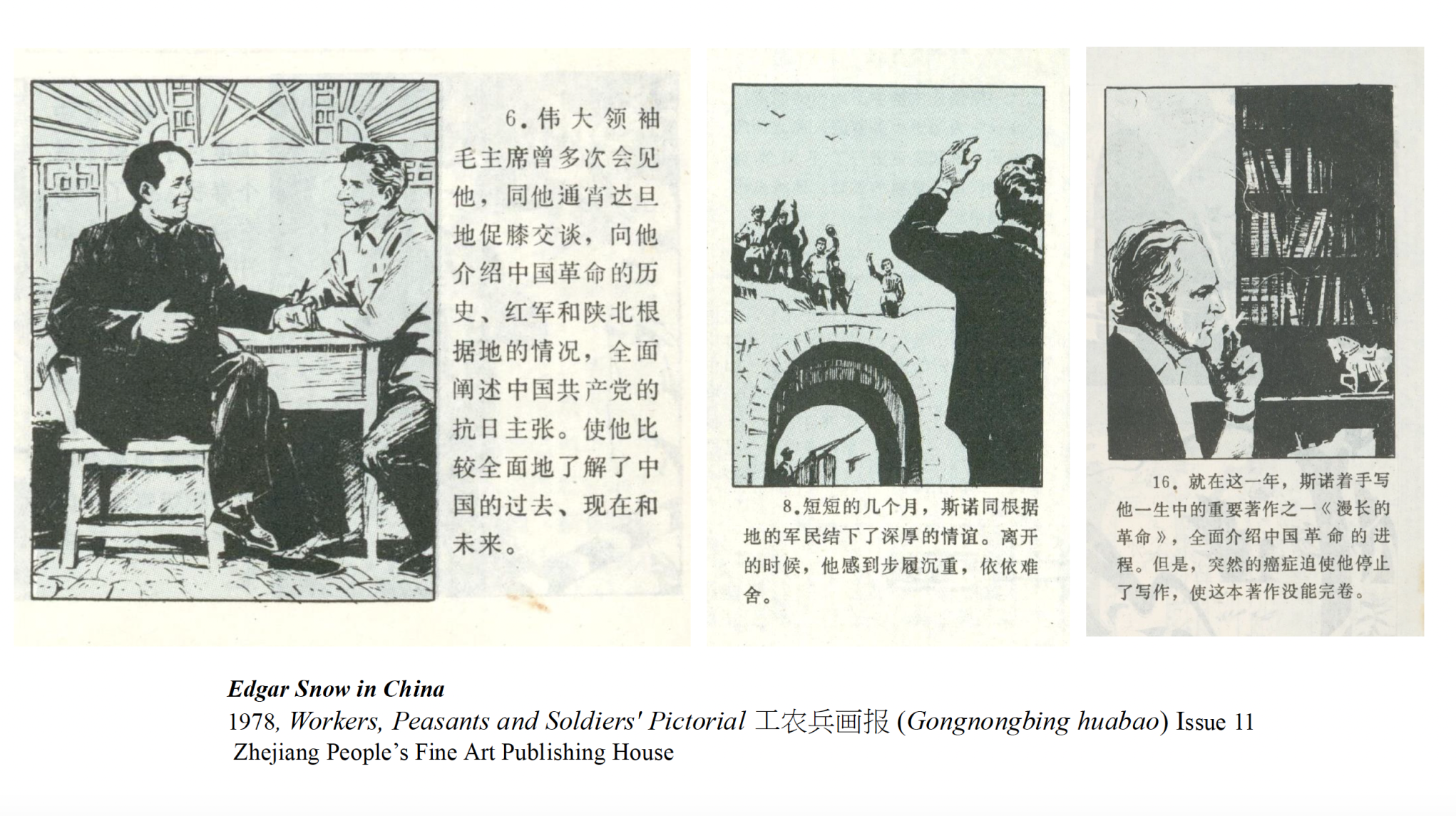
The last lianhuanhua I created was in 1978, shortly after the Cultural Revolution ended. It was published in the Workers, Peasants and Soldiers’ Pictorial 工农兵画报 (Gongnongbing huabao) in Hangzhou. This publication was founded during the Cultural Revolution and can be seen as the successor to the earlier Leap Forward Pictorial. It was the same size. I contributed a black-and-white fine line drawing about the American writer Edgar Snow. Snow was the first Western journalist to interview the Chinese Communist leader Mao Zedong, and Snow’s book Red Star Over China, published in 1937, was a firsthand report of the Chinese Communist Party regime. He died in 1972 and is still remembered by many Chinese people. When I was working on this lianhuanhua, I never imagined that, two years later, I myself would have the opportunity to travel to Snow’s country. I went to the United States for the first time in 1981 and began another chapter of my artistic life.
Looking back now, I realize that lianhuanhua accompanied almost every stage of my journey: first as a reader, then as an artist, editor, publisher, and teacher. For many people outside China, lianhuanhua may seem like a vanished popular medium, but for my generation, these little picture books shaped how we imagined history, politics, storytelling, and visual culture itself. They were small books, but they contained very large worlds. Thank you.
JD: Thank you both very much. That was an incredible journey. I am sure that the audience will have lots of questions, but first, I would be interested to know more about the people you worked with. Sheng, you say that creating lianhuanhua was a collaborative project. Could you tell us more about your team—your colleagues and students—and how you worked together?
ZST: Not too long ago, I was asked to write something to commemorate a colleague, Lin Yiyou 林以友. He was my schoolmate, then my colleague at the Hangzhou Academy. Later he transferred to Fujian Province, where he became a professor at the Fujian Normal University. He passed away in the late 1980s of a heart attack. I have kept a relationship with his two daughters, one who lives in Vancouver and another in New York. They wanted to publish a book about their father and asked me to write something about him.
Because we were two artists at that time, in the 1950s, we were active in making lianhuanhua. Lin was very fast and he liked sketching. If the story had a hundred pages, probably five hundred different figures would appear in it. There was always a lot of action, a lot of gesture, and different characters—men, women, children, all kinds of people. Lin exemplified how you needed to have imagination and to draw quickly to succeed at making lianhuanhua. I would say the first most important skill was imagination, and the second, sketching. The third was composition. You had to be able to think about different kinds of composition, like the director of a film, creating family scenes, village scenes, scenes in a factory or a foreign city. You had to imagine all kinds of things. I have always believed that Chinese cinema and Chinese filmmakers, especially Zhang Yimou 张艺谋 and other early directors, were inspired by lianhuanhua.
Lin was incredible at all of this. He was considered one of the fastest artists working in lianhuanhua. Every publishing house liked his work, and I remember that, when I started as an editor of lianhuanhua, he was my favorite, too. Once, we were both hired (or, really, assigned) to work for an exhibition supporting the Vietnamese war effort against the United States. We had to make numerous colored lianhuanhua in just a few days. We worked day and night, day and night. But we were very young at the time, so we could work until 2am, then ride our bicycles back to our homes at 3am. The work was exhibited in Hangzhou.
JD: Thank you very much for another vivid recollection of that time.
Kuiyi, I also have a question for you. Behind the artists and the scriptwriters were the publishing houses. As you described, in the early days, the 1930s and ’40s, there were hundreds of publishers in Shanghai, which was probably one of the most cosmopolitan, international, affluent cities in the world at that time. But by the end of the 1950s, there was only one: the Shanghai People’s Fine Arts Publishing House. How did that happen? How was it that Mao and his administration were able to combine and consolidate all those companies?
KS: The process was quite complicated. Between 1949 and 1951, the Chinese government still allowed almost all private companies to exist. Most lianhuanhua artists at the time worked for small, private publishing houses, but by 1952, these small publishers started to be combined. First, nine small privately owned publishers merged with a section of the newly established state publisher, East China People’s Art Publishing House 华东人民美术出版社, to establish a joint state-private ownership called New Art Press 新美术出版社. Many of the famous lianhuanhua artists in Shanghai joined this new publisher, bringing some of their disciples with them.
The next step of the merger was under the 1956 nationwide nationalization of industry. At that time the New Art Press was combined with the East China’s People’s Art Publishing House to establish the fully state-owned Shanghai People’s Fine Arts Publishing House上海人民美术出版社. By then, all private publishers had to relinquish their ownership to the state-owned company, and the consolidation was complete. From that point onward, private publishers no longer existed.
Actually, lianhuanhua were a very important part of the operations of the Shanghai People’s Fine Arts Publishing House. This publisher organized lianhuanhua training classes, which attracted many young artists and students. They also established two departments, one for the artists of lianhuanhua and the other, an editorial department, that created scripts. These two departments worked closely together, with the editorial department responsible for adapting stories from dramas, novels, and literature into lianhuanhua. So, in summary, the consolidation of art publishing houses started in 1952, and from 1952 to 1956, the process was in transition.
JD: Thank you. Let’s now take questions from the audience.
Audience: I’m interested in how your team traveled to villages to study from life. It seems in opposition to the idea that lianhuanhua required a really rapid turnaround. What was it that enabled your team to travel to Mongolia or to Shunyi to study? Were these trips timed so that you could prepare for the blockbuster productions of the year?
ZST: In art school, our program always emphasized something called tiyan shenghuo 体验生活. I don’t know how to translate it.
JD: “Experience life.”
ZST: Yes, that’s right. In China at the time, most students came from the city. How can a city boy or a city girl create realistic images of peasants, workers, or the minority if they didn’t know about the lives of these people? At that time, it wasn’t easy to learn through media channels. The best way to teach students was to send them to the countryside or to the factory to see things for themselves.
So, that’s how we started to teach lianhuanhua artists, the same way we trained other types of artists. In 1958, I remember our first class bringing twelve students to a factory in Hangzhou. We stayed with the workers and made a lot of sketches, and we learned their stories, some more interesting than others. For example, one story could be about a worker helping to repair a machine, and thus increase the factory’s production. Something like that. If everybody agreed that it was a good story, then you would make a drawing about the worker, then of the machine, the woodshop, the site, and so on. In this way, you were not working with an empty mind; you were working with very solid reference material. And that made things much easier, having a solid image in mind that you could remember and rely on.
That is the reason we traveled to the countryside or to factories. I really enjoyed it. If you do not go to the actual locations, to “experience life” there, then what you paint can look fake or superficial. You don’t have the details. When I was working on Master of the Grasslands, which is a story about a Mongolian woman who was sent to the hospital (she had a kind of tumor), I visited a clinic in a very rural area of Inner Mongolia and I sketched everything—all the furniture, the equipment, even the clothes the hospital workers wore. And we encouraged our students to do the same.
Audience: Thank you for these wonderful presentations. It appears that the lianhuanhua genre started in the nineteenth century, during the Qing dynasty, and its trajectory paralleled what was happening around the world in terms of the development of comics in the West, manga in Japan, and other similar popular art forms. I am also aware that, during this time, translated European literature was entering China. You mentioned, for example, the Sherlock Holmes series, which I understand was originally translated by somebody from Fujian, which is why “Holmes” was translated as Fuermosi 福尔摩斯.
In terms of European comics, Tintin was created in 1929. Was anybody in China during the 1930s and ’40s exposed to it or other Western comics? Did this have an impact on the creation of lianhuanhua, whether in style, format, or content?
KS: Comics and cartoon strips in the U.S. and Europe never really assumed the same format as Chinese lianhuanhua. On the other hand, Chinese cartoonists and comic artists were indeed influenced by Western models. Conceptually, then, yes, you can trace a link between the two.
Audience: My question is about the style used in lianhuanhua during the 1930s and ’40s in Shanghai. One thinks about the distinctive calendar art or advertisements during that period that seem to favor alluring women in form-fitting qipao. Was there a single style in that cosmopolitan Shanghai period that superseded all?
KS: The Shanghai period didn’t have a single style. Shanghai was a huge metropolis and very cosmopolitan. One could identify influences coming from many different directions. We mentioned European and American influences, but there was a very strong influence from Japan, as well, through manga. So, there was no one dominant style or way of depicting images. The styles were quite diverse, although later in the 1950s, a certain kind of line drawing became more prevalent and promoted by the Communist Party. This was true especially in the late 1950s and early 1960s.
JD: Thank you, Professors Shen and Zheng, for these wonderful presentations and fascinating insights into this unique art form. Please, let’s give them a round of applause.